Why Importers Are Comparing the Two Origins Now
Vietnam and Ecuador have never been direct clones of each other. One sells volume. The other sells craft. For years, that difference kept them in separate lanes.
That is changing. Ecuador keeps pushing into processed items. Vietnam keeps pushing into China, which used to be Ecuador’s backyard. The lanes are merging, and buyers feel the squeeze.
Then there is the tariff story in the United States. A proposed 40% duty on Ecuador shrimp has not passed yet, but it is enough to make procurement teams nervous. Nobody wants to sign a twelve-month contract and watch the landed cost jump overnight.
So the Vietnam Shrimp vs Ecuador Shrimp debate is really about risk. Where can you lock in a predictable cost? Where can you hedge? Let’s look at the data first.
Vietnam Shrimp Performance in the First 9 Months of 2026
Numbers tell the story better than opinions. Vietnam’s shrimp export figures for the first three quarters of 2026 show a market that is growing, but not evenly.

$3.7 Billion in Shrimp Exports, Up 11% Year on Year
Vietnam shipped roughly $3.7 billion worth of shrimp in the first nine months of 2026. That is an 11% increase compared with the same period last year.
For an industry that spent the past few years dealing with soft demand and price pressure, 11% is a solid result. Not spectacular. Not a boom. But steady, and steady is underrated.
What makes the figure interesting is where the growth came from. It was not spread evenly across the map. Far from it.
A Split Market: China and CPTPP Up, the US and EU Down
Here is the breakdown that matters for your planning:
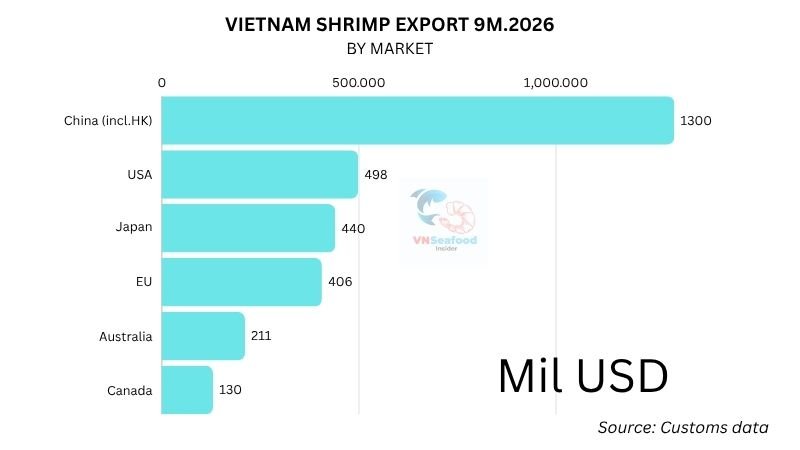
China is the engine. A 35% jump pushed it close to $1.3 billion, making it comfortably Vietnam’s largest shrimp buyer. CPTPP markets followed the same upward curve, with Australia leading at 18.5%.
The United States went the other way. A 15% drop to $498 million reflects tariff pressure and cautious buying. The EU slipped 4.9%, a milder decline but still a decline.
The pattern is clear. Vietnamese exporters are rotating toward Asia and the Pacific while the Atlantic markets cool off. If you buy for the US or EU, you are now competing for supply with Chinese and Japanese buyers who are paying well and paying fast.
See more: Vietnam seafood export 9 months 2026
Vietnam Shrimp vs Ecuador Shrimp: US Tariff Outlook
The US market is where the Vietnam Shrimp vs Ecuador Shrimp comparison gets complicated. Both origins face duties. The structures are different, and the difference is worth real money.
The Proposed 40% Tariff on Ecuador Shrimp (Not Yet Approved)
Let’s be precise here, because rumors travel faster than facts in this industry.
There is a draft proposal to apply a duty of up to 40% on Ecuador shrimp entering the United States. It has not been approved. It is a proposal, nothing more, and it may be revised or dropped entirely.
Today, Ecuador carries a countervailing duty of roughly 3.78% for cooperating companies, plus an additional tariff of around 15%. Importantly, Ecuador has largely avoided the company-specific anti-dumping duties that Vietnamese exporters live with.
Vietnam’s situation looks like this: anti-dumping duties assigned per company, a CVD of 2.84% for cooperating firms, and an added 12.5% Section 301 tariff effective from 24 July 2026.
Meanwhile, India and Thailand are both carrying anti-dumping duties in the US market too. Nobody is walking duty-free.
What Tariff Changes Mean for Importers’ Landed Cost
Run the math and the picture becomes practical.
Right now, Ecuador’s total duty burden in the US sits around 18 to 19% for cooperating suppliers. Vietnam’s base is roughly 15% plus the company-specific ADD rate, which varies widely. For some Vietnamese exporters, that rate is low enough to make them genuinely competitive on landed cost.
If the 40% proposal ever passes, the arithmetic flips hard. Ecuador raw frozen shrimp would become difficult to justify for most US programs, and Vietnamese value-added products would absorb a large share of that volume almost immediately.
Our advice is simple. Do not restructure your entire shrimp sourcing plan around a proposal that has not passed. But do build a contingency. Ask your Vietnamese suppliers now what capacity they could commit to in Q1 2027. Being second in line is an expensive place to stand.
Vietnam Shrimp vs Ecuador Shrimp: Where Vietnam Has the Edge
Tariffs are only one layer. Geography and factory capability matter just as much, and in two specific areas Vietnam holds a clear advantage.
Shipping Time and Quality Advantages for the China Market
This is the obvious one, but it deserves spelling out.
Vietnam sits next door to China. Transit times are short, freight costs are lower, and cold chain exposure is minimal. Ecuador sits on the other side of the Pacific, with longer voyages and higher per-container costs.
Both origins enjoy 0% import duty on frozen shrimp into China. Ecuador gets there through its FTA schedule with Beijing. Vietnam gets there too. So the duty line is a tie, and the race is decided by freight and quality.
Chinese buyers have consistently paid more for Vietnamese products. Reference data puts Vietnamese import prices around $6.53 per kilogram against Ecuador’s $6.27. That premium is not an accident. It reflects better handling, better presentation, and shorter time from harvest to port.
Ecuador is still China’s largest supplier by volume, and that will not change soon. But in the segments that care about quality, Vietnam is winning the China shrimp market share it is going after.
Value-Added Shrimp Such as Breaded Shrimp
If China is Vietnam’s geographic advantage, processing is its structural one.
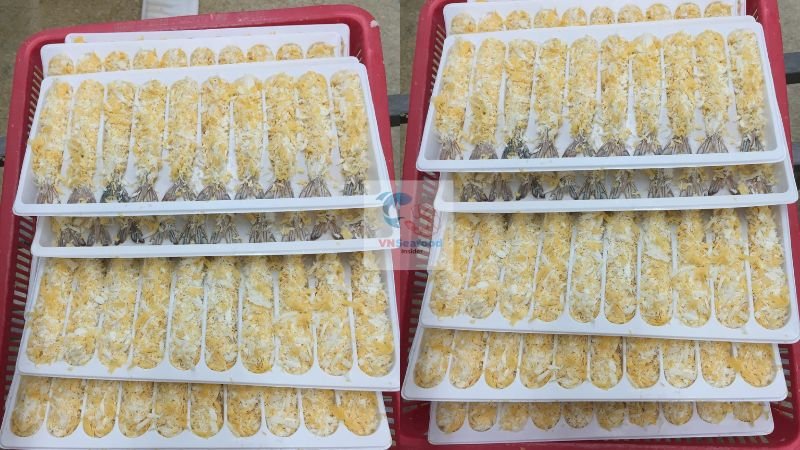
Vietnamese factories have spent two decades building skill in value-added shrimp. Breaded shrimp, sushi ebi, seasoned product, retail packs, private label programs with tight specifications. This is the bread and butter of the industry here.

Ecuador’s strength lies elsewhere. HLSO, PD, PDTO, IQF, block frozen. Large volumes of consistent raw material at competitive prices with uniform sizing. It is an excellent model, just a different one.
For a US retailer building a private label breaded line, Vietnam is not merely an option. It is the practical choice. The Vietnam Shrimp vs Ecuador Shrimp question answers itself the moment your spec sheet includes a batter formula.
Q4 Risks When Sourcing Vietnam Shrimp vs Ecuador Shrimp
Now for the part nobody enjoys reading. Q4 carries real risks, and pretending otherwise helps nobody.
Rainy Season and Shrimp Disease Risk
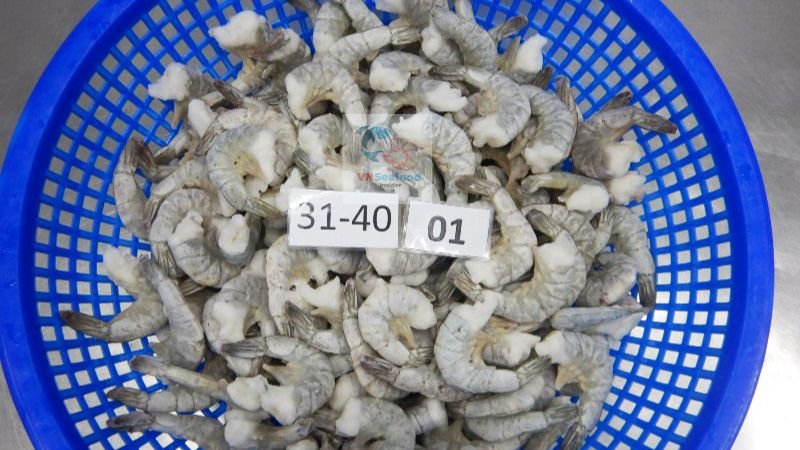
Rain changes everything in a shrimp pond. Salinity drops, water temperature swings, pH moves, and stressed shrimp get sick.
Disease outbreaks during the rainy season can tighten raw material supply with very little warning. Prices firm up. Delivery schedules slip by a week or two. Farmers harvest early to cut losses, which means more small sizes and fewer of the counts you probably ordered.
Build a buffer into your timeline. A ten-day cushion costs you nothing. A missed promotion window costs you plenty.
See more: AHPND and WSSV: Critical Vannamei Shrimp Diseases Every Seafood Importer Should Know
Strict Antibiotic Residue Standards in the EU
The European Union does not negotiate on antibiotic residues. Testing is rigorous, thresholds are low, and one rejected container can put a supplier on a watch list for a long time.
If the EU is part of your program, insist on third-party testing before loading. Ask for the full treatment history of the pond. Reputable Vietnamese exporters are used to this and will provide documentation without complaint. The ones who hesitate are telling you something.
Geopolitical Tensions and Year-End Ocean Freight Rates
Here is where it stops being about shrimp at all.
Ongoing conflicts and political instability have pushed ocean freight rates sharply higher. Q4 makes it worse, because every industry on earth is shipping at once for the holidays. Space gets scarce and rates climb accordingly.
A freight spike can quietly erase the margin you fought for during price negotiation. Vietnam generally holds a freight advantage over Ecuador on US-bound routes, and a very large one on China-bound routes. But nobody is immune when rates jump across the board.
How to Plan Q4 Orders: Vietnam Shrimp vs Ecuador Shrimp
Enough analysis. Here is what we would actually do.
Diversify Origins by Market and Product Type
Stop thinking about this as choosing a winner. Think of it as assigning roles.
Place your value-added and private label programs with Vietnam, where the processing skill lives. Place large-volume raw frozen commodity orders with Ecuador, where the cost structure is built for it. For China-bound business, lean on Vietnam for freight efficiency and quality premium.
Split origins within the same product line if your volume allows it. It is the cheapest insurance policy in the business.
Lock In Freight and Quality Checks Early
Book your Q4 space now, not in November. Rates will not get friendlier as December approaches.
Set up pre-shipment inspection before production starts, not after. Agree on testing scope, sample sizes, and who pays for what. Write it into the contract so there is nothing to argue about later.
And talk to your supplier about the tariff scenarios. A good partner will tell you honestly what they can absorb and what they cannot.
Vietnam Shrimp vs Ecuador Shrimp: Final Takeaways
Vietnam’s $3.7 billion in exports, up 11%, shows an industry finding its footing in new markets. China at +35%, Australia at +18.5%, Canada at +11%. The US and EU are soft, but the overall direction is up.
The Vietnam Shrimp vs Ecuador Shrimp comparison has no single winner. Vietnam owns value-added processing and the China freight advantage. Ecuador owns scale and raw frozen pricing. Smart importers use both.
Watch the 40% proposal, but do not bet your Q4 on it. Build buffers for rain and freight. Test everything bound for Europe.
See more: Vietnam Shrimp Export: Complete Guide for Importers & Distributors
Plan early, split your risk, and you will sleep better in December. VNSeafoodInsider will keep watching the numbers for you.
