
If you buy shrimp for a living, you already know the drill. A supplier sends you a quote. Another one sends a cheaper quote. And somewhere in between, you have to decide which number actually makes sense for your business.
At VNSeafoodInsider, we hear the same question almost every week: is the Vietnam shrimp price competitive compared with Thailand, India, Indonesia and Ecuador? The short answer is “it depends on the size and the market.” The long answer is this article.
Let’s walk through the numbers together, then talk about what sits behind them.
Vietnam Shrimp Price at a Glance: Where Vietnam Ranks Among 5 Origins
Before we dive into size-by-size tables, it helps to zoom out. Five origins dominate global shrimp trade conversations, and each one plays a different game. Some compete on volume. Some compete on processing. And one competes on being the cheapest kid on the block.
Vietnam Shrimp Price vs Thailand, India, Indonesia and Ecuador
Here is the current snapshot, in USD per kg (in early Nov 2026)
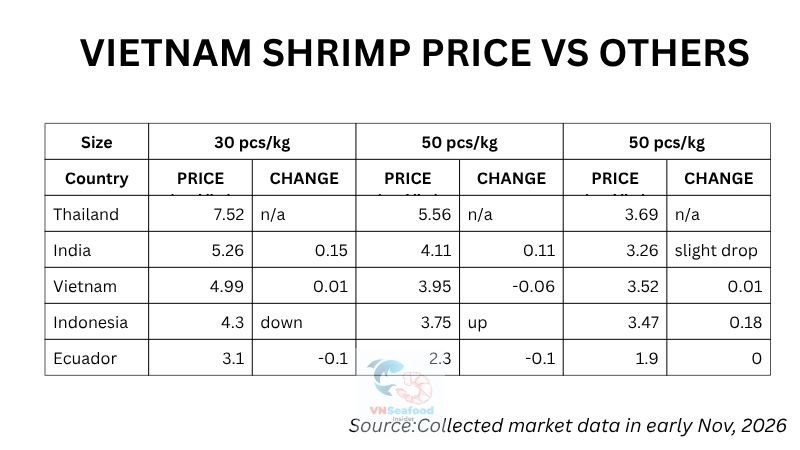
Read it once and the ranking is clear. Thailand sits at the top. Ecuador sits at the bottom. The Vietnam shrimp price lands in the middle, slightly below India, slightly above Indonesia.
That middle position is not an accident. It is a strategy.
Why Price per Kg Is Only Part of the Sourcing Decision
Here is the part that raw numbers never tell you. A raw block price and a landed, processed, certified, ready-to-sell price are two very different animals.
Vietnam’s biggest strength is not cheap shrimp. It is value-added shrimp processing — peeled, deveined, skewered, breaded, cooked, nobashi, ring-shaped, whatever your retailer asked for last quarter. Add strong traceability, consistent food safety documentation, and tariff advantages under CPTPP, EVFTA and similar agreements, and the shrimp price per kg starts to look like only one line in a much longer spreadsheet.
So yes, compare prices. Just compare the whole picture too.

Vietnam Shrimp Price by Size: 30, 50 and 80 Count per Kg Compared
Size changes everything in shrimp. Big shrimp is a different market from small shrimp, with different buyers, different margins, and different competitors. Let’s break it down.
Vietnam Shrimp Price for 30 Count/Kg vs Competitors
At 30 pcs/kg, Vietnam quotes 4.99 USD/kg, up a penny from the previous reading. India sits at 5.26, which is 0.27 higher and moving up faster at +0.15. Thailand is way out at 7.52, playing in a premium league of its own.
Ecuador, meanwhile, offers 3.10 USD/kg. That is a 1.89 gap below Vietnam. It is a big number, and we are not going to pretend otherwise.
But large-size shrimp is also where Vietnamese processing shines, because this is the size that ends up in retail packs, foodservice portions and premium Japanese and Korean channels. For those buyers, the Vietnam shrimp price at 30 count is often the best balance between cost and finished quality.
Vietnam Shrimp Price for 50 Count/Kg vs Competitors
Mid-size is where things get interesting. Vietnam quotes 3.95 USD/kg at 50 pcs/kg, and it is one of the few origins that actually eased slightly, down 0.06.
India is at 4.11 and rising. Indonesia is at 3.75 and also rising. Thailand remains premium at 5.56. Ecuador stays at 2.30.
Translation: Vietnam just became a touch more attractive versus India in this size bracket, while Indonesia closes the gap from below. If you buy 50 count regularly, this is the moment to re-run your comparisons.
Vietnam Shrimp Price for 80 Count/Kg vs Competitors
Small size is the toughest battlefield for Vietnam. At 80 pcs/kg, Vietnam sits at 3.52 USD/kg — above India at 3.26 and above Indonesia at 3.47. Thailand is 3.69. Ecuador is 1.90.
Why is Vietnam not the cheapest here? Because small shrimp is a volume game, and volume games reward whoever has the lowest farming cost. Vietnam’s farming cost structure is simply higher than Ecuador’s or India’s.
The honest advice from VNSeafoodInsider: if you need commodity-grade small shrimp at rock-bottom cost, Vietnam is not your first call. If you need small shrimp that has been peeled, cooked and certified for a European retailer, suddenly the Vietnam shrimp export price starts making a lot more sense.
How Competitors Shape the Vietnam Shrimp Price Gap
No price exists in isolation. Every quote you receive from Vietnam has been shaped, nudged and pressured by what other origins are doing. Here is who is doing what.
Ecuador: Lower Prices and Rising Export Volume
Ecuador is the elephant in the room, and it keeps getting bigger. Export volume rose 19.8% year on year in the comparable period, while prices actually drifted down — 0.10 lower at both 30 and 50 count.
More supply plus lower prices equals downward pressure on everyone. Ecuador’s advantage comes from large-scale, low-density farming close to deep-water ports, which keeps costs low and logistics simple. It is a genuine structural advantage, not a temporary promotion.
India: Price Position and Growing Risk in the US Market
India sits just above Vietnam on the large sizes and just below on the small ones. But India’s story right now is less about price and more about risk.
On 28 October, US shrimp producers filed a complaint with the US International Trade Commission alleging that Indian shrimp from Nekkanti Sea Foods was produced using forced labor, giving the company an unfair cost advantage through labor rights violations. If that complaint advances, Indian shrimp could face restricted access to the US market.
For importers comparing the Vietnam shrimp price against India, that is a supply-continuity question, not just a cost question.
Indonesia and Thailand: Mid-Range and Premium Pricing
Indonesia is the quiet competitor. At 4.30, 3.75 and 3.47 across the three sizes, it undercuts Vietnam on the two larger counts and is rising on the smaller ones. Indonesia competes directly with Vietnam in several processed categories, especially for US and Japanese buyers.
Thailand plays an entirely different game. At 7.52 for 30 count, nobody is buying Thai shrimp because it is cheap. Thailand sells reputation, long-standing processing expertise and established buyer relationships. It is the Rolex of this table — and like a Rolex, the volume is small relative to the price.
Vietnam Shrimp Export Performance Behind the Price Trend
Prices tell you what things cost. Export data tells you whether anyone is actually buying. Let’s look at the trade numbers behind the quotes.
October Shrimp Exports: What the Latest Numbers Show
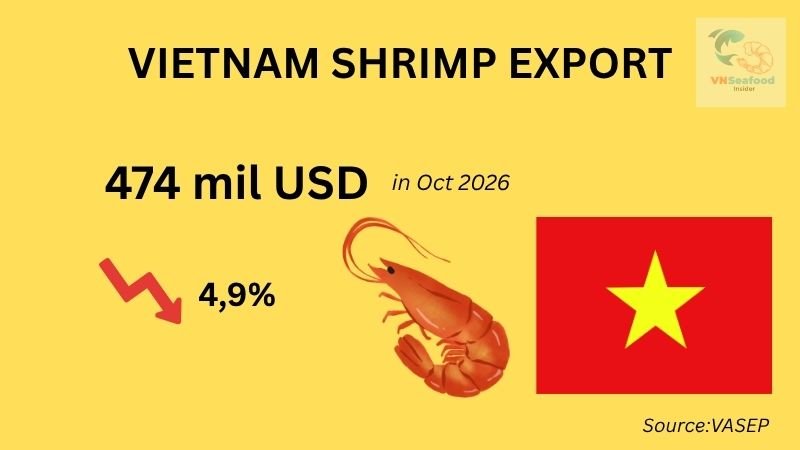
October shrimp exports reached nearly USD 474 million, down 4.9% year on year. Whiteleg shrimp alone fell 8.3% to roughly USD 307 million.
That is a softer month than many exporters hoped for. It also explains why the Vietnam shrimp price has been moving in tiny increments rather than making any dramatic jumps. When demand is flat, prices sit still.
Vannamei Shrimp vs Green Lobster: Where Export Growth Is Coming From
Here is a detail most price tables miss. Over ten months, whiteleg shrimp (vannamei) exports reached USD 2.62 billion — up only 4%. Green lobster, meanwhile, hit nearly USD 915 million, up 31%, contributing over USD 216 million of new value. That is roughly 62% of all the growth in Vietnam’s entire shrimp category.
In plain English: the headline 9% growth in Vietnamese shrimp exports is being carried on the back of lobster, not whiteleg shrimp. The core farmed-and-processed shrimp business is growing slowly.
For you as an importer, that means suppliers are hungry for whiteleg volume. Hungry suppliers negotiate.
Global Import Demand in the US, EU and China
Over eight months, US shrimp imports fell 0.7% and EU imports fell 2.3%. China, in contrast, surged 25.5%.
So demand is not collapsing — it is relocating. Western markets are soft while Asia absorbs more. Since Ecuador ships heavily to China, that at least takes some Ecuadorian pressure off Western shelves. But it is not enough to lift the whole market.
Do not expect a rising tide to float the Vietnam shrimp price before year-end. It is not coming.
Anti-Dumping POR20 and Its Impact on Vietnam Shrimp Price for US Buyers
If you import into the United States, there is one more number you must add to every quote. It is not optional, and it changes the math completely.
Preliminary POR20 Duty Rates by Exporter
The preliminary POR20 results set anti-dumping duties as follows:
- STAPIMEX: 6.30%
- Fimex group: 10.76%
- 27 separate-rate companies: 7.56%
Final results were expected in early November. Those rates directly shape both cost and the ability to close US orders.
What the Final Results Could Mean for Landed Cost
Run the arithmetic. A 50-count quote of 3.95 USD/kg becomes about 4.20 with a 6.30% duty, around 4.25 at 7.56%, and roughly 4.38 at 10.76%.
Suddenly the gap versus India at 4.11 looks very different. Same shrimp, same size, different exporter — and a 43-cent spread appears out of nowhere.
How to Compare Vietnam Shrimp Price Fairly with the Duty Included
Our standing advice at VNSeafoodInsider is simple. Always ask for the exporter’s specific POR rate before you compare anything. Build your comparison on duty-paid, landed cost, not FOB. And if you sell outside the US, ignore the duty entirely — it does not apply to you, and some suppliers may quote more aggressively for non-US destinations.
Read more: Section 301 Seafood Tariff Explained: New US Duty Rates on Vietnam Seafood from July 2026
Could the India Forced Labor Complaint Change Vietnam Shrimp Price Competitiveness?
Trade cases rarely resolve quickly, but they do reshape buying behavior long before any ruling arrives. This one is worth watching closely.
What the ITC Complaint Against Indian Shrimp Alleges
Filed in late Oct, 2026 by US shrimp producers, the complaint alleges that Nekkanti Sea Foods gained an unfair competitive advantage by violating workers’ rights and cutting labor costs, and asks the ITC to block imports of Indian shrimp allegedly produced with forced labor.
Possible Opportunities for Vietnamese Exporters in the US Market
If the complaint succeeds, Indian shrimp volumes into the US could shrink. Somebody has to fill that shelf space. Vietnam, with established US relationships, strong processing capability and documented traceability, is a natural candidate.
That scenario could firm up the Vietnam shrimp price for US-bound orders. It is a possibility, not a promise — but it is the kind of possibility worth factoring into your Q1 planning.
Vietnam Shrimp Price Outlook for Importers: What to Expect Before Year-End
So where does all this leave your buying calendar? Let’s be practical about the next few months.
Why a Market-Wide Price Rise Is Unlikely Soon
Three reasons. US and EU import demand is still negative. Ecuador’s volume is up nearly 20% and its prices are drifting down. And Vietnam’s own whiteleg exports fell 8.3% in October.
Unless something unexpected happens, the Vietnam shrimp price should stay in its narrow current band — moving by cents, not dollars.
Practical Tips for Importers Negotiating Vietnam Shrimp Price
A few things that genuinely work:
- Lock larger sizes now. The 30-count trend is upward across India and Vietnam.
- Negotiate harder on 50 count. Vietnam eased 0.06 while competitors rose.
- Ask for the POR20 rate before anything else if you ship to the US.
- Compare value-added specifications, not raw blocks, where Vietnam genuinely wins.
- Split your sourcing. Ecuador for commodity volume, Vietnam for processed and certified lines.
Read more: Vietnam Seafood Export 9 Months 2026: $9.1B, Up 11.4%
Frequently Asked Questions About Vietnam Shrimp Price
Quick answers to the questions that land in our inbox most often.
Is Vietnam Shrimp Price Lower Than India and Thailand?
Versus Thailand, yes, substantially, at every size. Versus India, yes at 30 and 50 count — 4.99 vs 5.26 and 3.95 vs 4.11 — but no at 80 count, where Vietnam is 3.52 against India’s 3.26.
Why Is Ecuador Shrimp Cheaper Than Vietnam Shrimp?
Lower farming costs, enormous scale, low-density ponds and short logistics to deep-water ports. Ecuador mostly sells raw, less-processed product, while Vietnam invests in processing that adds cost — and value.
Does Anti-Dumping Duty Affect Vietnam Shrimp Price for All Exporters?
No. Rates differ by company: 6.30% for STAPIMEX, 10.76% for the Fimex group, 7.56% for 27 separate-rate companies. And it only applies to US-bound shipments.
How Can Importers Get a Reliable Vietnam Shrimp Price Quote?
Specify size count, species, processing form, glazing percentage, packaging and destination port. Then ask for the duty rate and the certifications. A quote without those details is a guess wearing a suit.
Conclusion: Is Vietnam Shrimp Price Competitive for Importers?
Here is our honest verdict.
Vietnam will never beat Ecuador on raw price. That fight is over, and Ecuador won it. Vietnam also loses to India and Indonesia on small sizes.
But at 30 and 50 count, the Vietnam shrimp price undercuts India and dramatically undercuts Thailand. Add deep processing capability, reliable traceability, strong food-safety records and preferential tariffs into the EU, Japan, Korea, Australia and CPTPP markets, and Vietnam becomes very competitive indeed — just not in the column you were looking at first.
Compare landed cost, not FOB. Compare finished specification, not raw block. Do that, and Vietnam holds up well.
If you want current, destination-specific quotes with duty rates included, VNSeafoodInsider is happy to help you build a comparison that actually reflects your business.
