Why Global Importers Choose Vietnam for Seafood
The case for Vietnam as a seafood sourcing hub goes well beyond competitive pricing, though pricing matters. What has made Vietnam a preferred supplier for major retail chains, food service distributors, and regional importers across North America, Europe, and Asia is a combination of structural advantages that are difficult for competitors to replicate quickly.
Geographic endowment. Vietnam’s 3,260-kilometer coastline and the Mekong Delta — one of the world’s most productive freshwater ecosystems — create natural conditions for both wild-catch fisheries and aquaculture. The tropical climate supports year-round farming cycles, meaning supply consistency that seasonal-dependent producers in other countries cannot match.
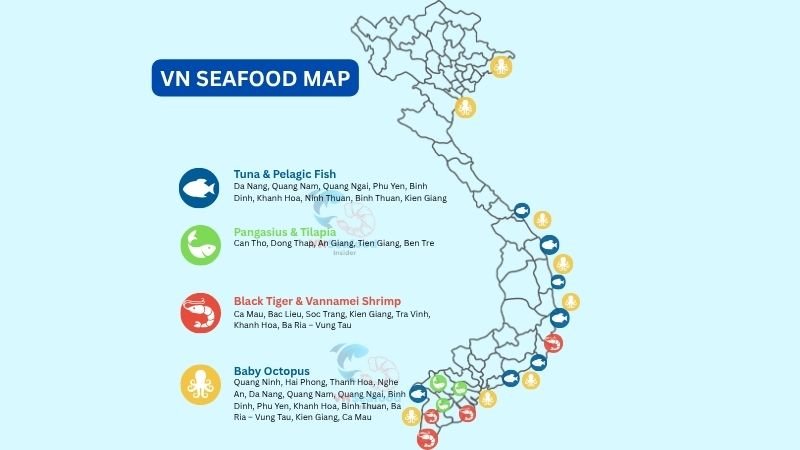
Below is the map of materials area for each seafood types:
Species breadth. Few countries can offer shrimp, pangasius, tuna, tilapia, barramundi, threadfin bream, mahi mahi, squid, octopus, crab, and lobster from a single supply base. For importers managing multi-species portfolios, consolidating sourcing into fewer supplier relationships has real logistical and cost advantages.
Processing infrastructure. The Vietnamese seafood processing industry has matured significantly over the past two decades. The major export-oriented processors operate modern IQF lines, blast freeze tunnels, and blast chill rooms. Many have invested in in-house laboratories capable of running residue and microbiological tests to international standards.
Certification adoption. Leading Vietnamese exporters hold internationally recognized certifications — ASC, BAP, GlobalG.A.P., HACCP, IFS, BRC — that are required by buyers in the US and EU. This is not universal across the industry, but the top tier of exporters has made certification a core part of their market access strategy.
Competitive cost structure. Labor costs in Vietnam remain lower than in many competing countries. Combined with feed cost impact and improving farming yields, this gives Vietnamese exporters meaningful pricing flexibility without compromising on quality at the top end of the market.
The result: Vietnam is no longer a backup option when primary suppliers fall short. For many buyers, it has become the primary source.
Key Products of Vietnam Seafood Export: A Buyer’s Overview
Understanding what Vietnam produces — and how each product category works — is the starting point for any serious sourcing conversation. Here is a concise overview of the five main export categories.
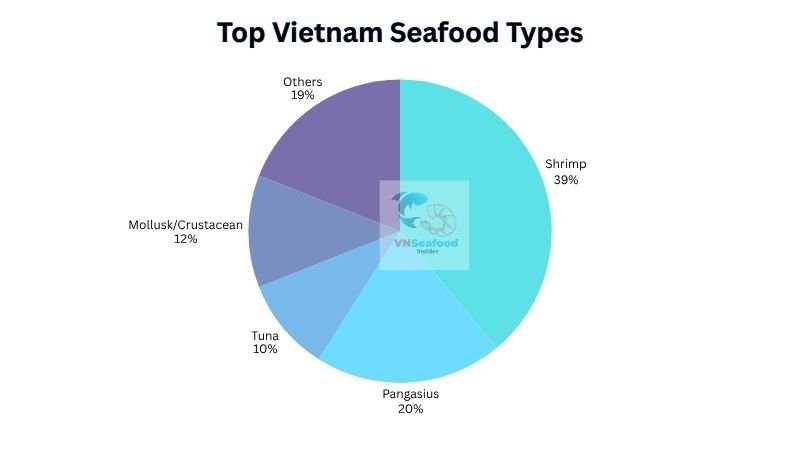
Shrimp (approximately 39% of total export value)
Shrimp is Vietnam’s flagship seafood export and the category with the deepest infrastructure. Two species dominate: Vannamei (white leg shrimp), which accounts for the vast majority of volume, and Black Tiger shrimp, which commands premium pricing in select markets.
Vietnamese shrimp is available in a wide range of processing formats — HLSO (head-less shell-on), PD (peeled and deveined), PUD (peeled un-deveined), cooked, and value-added preparations including marinated and breaded products. The Mekong Delta provinces of Ca Mau, Bac Lieu, and Soc Trang are the primary production zones.
For importers sourcing shrimp, the key variables to track are disease pressure in the farming regions (EMS and white spot remain ongoing risks), antidumping duty rates in the US market (which vary significantly by exporter), and the seasonal production calendar.
→ For a complete sourcing guide on Vietnamese shrimp, see our dedicated page on sourcing shrimp from Vietnam.
Pangasius / Basa (approximately 20% of total)
Vietnam holds a near-monopoly position in global pangasius supply. The Mekong Delta’s natural hydrology — continuous flowing water from the river system — creates conditions that give Vietnamese pangasius its characteristic white, firm fillet profile. Competitors in other countries have struggled to replicate this at commercial scale.
Pangasius exports from Vietnam are dominated by the skinless boneless fillet format, typically IQF-frozen. The product is sold into a wide range of markets: retail in Eastern Europe and Brazil, food service in the US, and institutional buyers in China and the Middle East.
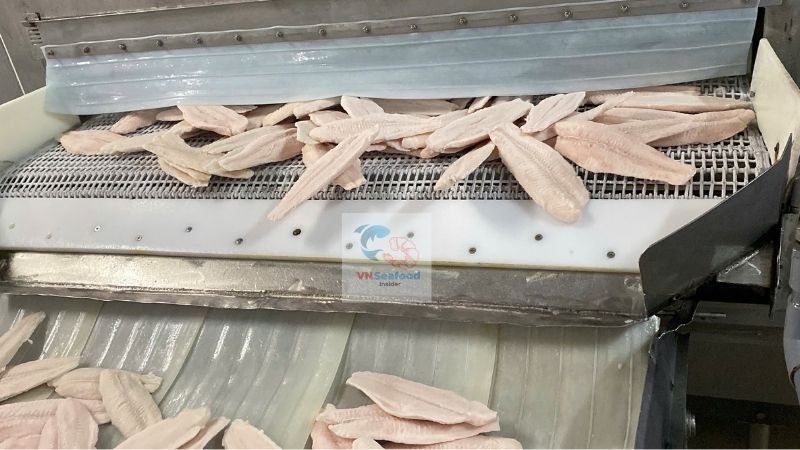
Quality variation is the central challenge in this category. The gap between a well-run pangasius processor and a cost-cutting operation shows up in moisture content, phosphate treatment levels, and fillet color. The European Union enforces strict limits on phosphate content in pangasius fillets — buyers targeting the EU market need to specify and verify compliance before ordering.
→ For a detailed breakdown of pangasius quality grades, pricing, and import process, see our guide on importing pangasius from Vietnam.
Tuna (approximately 10% of total)
Vietnam’s tuna export sector is centered on yellowfin tuna, with smaller volumes of skipjack and bigeye. Products range from fresh and frozen loins and steaks to sashimi-grade whole fish and canned preparations.
The tuna industry is navigating a more complex regulatory environment than other species. In the US market, MMPA (Marine Mammal Protection Act) compliance requirements that took effect in 2026 have created significant compliance hurdles for Vietnamese tuna fisheries using certain net types. In the EU market, access to preferential tariffs under the EVFTA trade agreement is contingent on EUR1 certificates of origin — a documentation bottleneck that has constrained export growth into Europe.
For importers focused on tuna, regulatory compliance documentation from the supplier is non-negotiable. The story behind how the fish was caught matters as much as the product specification.
→ For the full picture on Vietnam’s tuna regulatory situation and market outlook, see our Vietnam tuna export guide.
White Fish and Other Species (approximately 19% of total)
Beyond the three headline categories, Vietnam exports a growing portfolio of white fish species that are attracting significant importer interest — partly driven by global supply disruptions in traditional white fish sources such as Alaska pollock and Chinese tilapia.
Tilapia has emerged as a significant growth category, particularly as Chinese tilapia faces severe US tariff headwinds. Vietnamese tilapia production is expanding rapidly, with farm-gate prices more than doubling in 2025 as export demand accelerated.
Barramundi (Asian sea bass) is one of the fastest-growing Vietnamese seafood export products, with strong demand in Australia, the US, and Europe. The fillet has a clean flavor profile and premium positioning that supports higher price points than commodity white fish.
Golden Threadfin Bream and Mahi Mahi round out the portfolio, with established export flows into Asian markets and growing interest from European and North American buyers looking to diversify away from more widely traded species.
→ For an overview of sourcing options across Vietnam’s white fish categories, see our Vietnam white fish sourcing guide.
Mollusks and Crustaceans (approximately 12% of total)
Squid, octopus, crab, and lobster round out Vietnam’s export portfolio and have been among the fastest-growing categories in recent years. Crab exports grew 56% in 2024, and lobster reached $412 million — driven primarily by surging demand from China. Vietnam’s soft-shell crab has developed a strong reputation in premium restaurant markets globally.
This category is less thoroughly covered in international sourcing databases, which means less competition for buyers willing to invest in relationship-building with specialist suppliers.
One of high-quality seafood that not many importers know about Vietnam is white clams. Vietnam annually export 120 mil USD of clams to the world. You can read more about Vietnamese white clams.
Apart from final products, there is The Big Opportunity in Vietnam Seafood By-Product Pet Food. Many importers contacted us for pet production purpose. The demand for pet food is growing year by year.
Top Destinations for Vietnam Seafood Exports
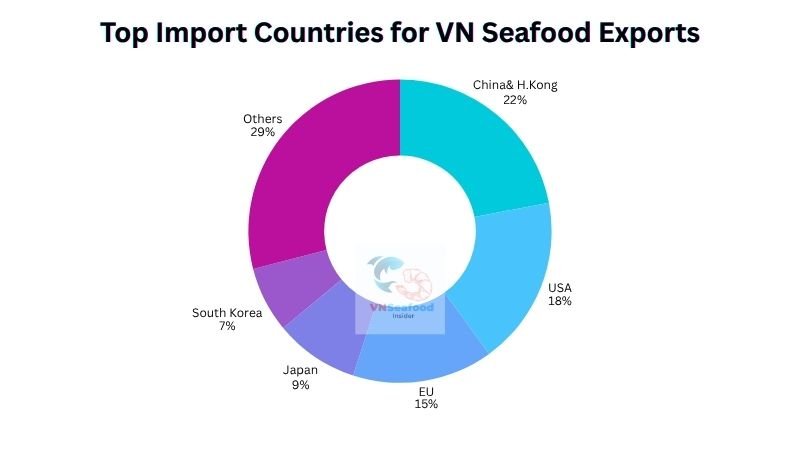
Vietnam’s export markets are genuinely diverse — no single market accounts for more than a quarter of total export value, which is a sign of the industry’s maturity and active market development efforts.
| Market | Approx. Share | Strongest Product Categories |
|---|---|---|
| China & Hong Kong | ~22% | Shrimp, lobster, crab, pangasius |
| United States | ~18% | Shrimp, pangasius, tuna |
| European Union | ~15% | Pangasius, tuna, mollusks |
| Japan | ~9% | Shrimp, tuna, mollusks |
| South Korea | ~7% | Shrimp, squid, white fish |
| Other markets | ~29% | Mixed |
United States. Despite antidumping duties on shrimp and ongoing tariff negotiations, Vietnam remains one of the top four shrimp suppliers to the US market. Pangasius and tuna also have strong US distribution presence. The US market rewards consistent quality and reliable supply more than any other single factor — importers who build long-term supplier relationships here tend to outperform those who shop purely on price.
European Union. The EU-Vietnam Free Trade Agreement (EVFTA) provides preferential tariff access for certified Vietnamese seafood — a significant advantage over competitors like India and Ecuador in certain product categories. However, the EU also has the strictest quality and residue requirements of any major market. Pangasius phosphate limits, tuna EUR1 documentation, and IUU fishing compliance are active issues that every EU-focused importer needs to understand before committing to a supply program.
China. The sheer volume of China’s appetite for Vietnamese seafood makes this the single largest market. Lobster, crab, and shrimp have driven particularly strong growth, supported by China’s expanding premium seafood consumption. The proximity advantage — shorter lead times and lower freight costs compared to Western markets — makes Vietnam the natural supplier of choice for Chinese buyers in many categories.
Japan and South Korea. Both markets prioritize quality and processing precision above almost everything else. Japanese buyers in particular have high expectations around traceability, packaging standards, and microbiological quality. Vietnamese suppliers who have built relationships with Japanese buyers have typically gone through a demanding qualification process — which also means their product quality is verified more rigorously than average. Furthermore, scallop processing Vietnam which materials originated from Japan is one of the most popular activities in recent years.
For the latest export statistics broken down by market and product category, see our Vietnam seafood export statistics report and 2026 early recovery update.
Seafood Quality and Certifications: What Importers Must Verify
Quality in the Vietnamese seafood industry is real — but it is not uniform. The difference between the top tier and the bottom tier of producers is significant enough to determine whether your first container becomes a long-term program or a costly lesson.
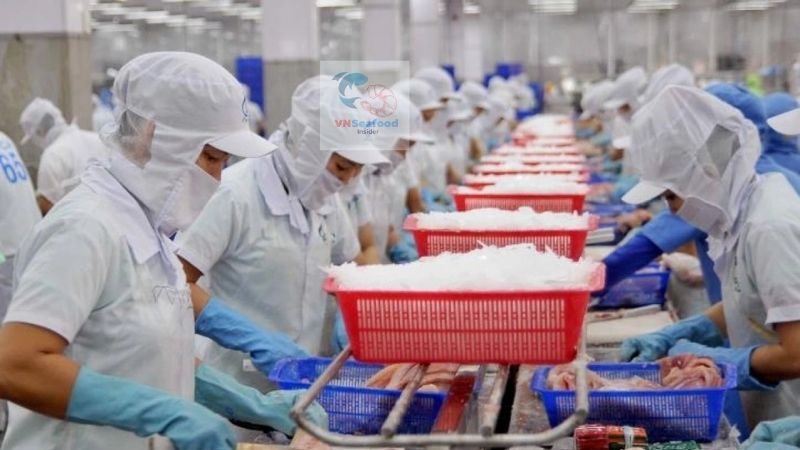
Certifications to require from your suppliers
The certification landscape is not complicated, but it requires active verification rather than passive acceptance of documents.
ASC (Aquaculture Stewardship Council) is the globally recognized benchmark for responsible aquaculture. It is required or strongly preferred by major retail chains in Europe and North America. For shrimp and pangasius specifically, ASC certification signals that farming practices meet environmental and social standards.
BAP (Best Aquaculture Practices) is widely specified by US food service and retail buyers. Many Vietnamese shrimp and pangasius processors hold BAP facility certification, which covers the processing plant; buyers should check whether the farms supplying those plants are also BAP-certified.
GlobalG.A.P. is the primary farm-level certification required by EU retail buyers. For suppliers targeting European supermarket chains, this is effectively a market entry requirement.
HACCP is the baseline food safety management system expected from any serious export-oriented processor. If a supplier cannot demonstrate HACCP implementation, that is a fundamental disqualifying signal.
IFS / BRC are retailer-specific certifications required by many European grocery chains. Essential if your distribution channel includes branded retail.
FDA registration is mandatory for any facility supplying product to the US market — not optional, not negotiable. Verify the registration number against the FDA’s online database.
One practical note: request the actual certificate with its unique identification number and verify it directly on the certifying body’s official website. Certificate fraud exists in this industry. A PDF alone is insufficient verification.
The quality issue that burns importers most often
The single most common quality problem reported by importers of Vietnamese seafood — particularly pangasius and shrimp — is excessive moisture through phosphate treatment or oversoaking. This practice inflates product weight, generates artificial margin on paper, and destroys texture quality in the end product.
The warning signs: product priced significantly below market benchmarks, excessive drip loss after thawing, mushy texture when cooked. The EU enforces a strict phosphate limit of 5g/kg in pangasius fillets; product exceeding this threshold is subject to rejection at the border.
Practical countermeasures: request laboratory moisture and phosphate analysis from recent production batches, run your own thaw-and-cook test on samples before confirming an order, and treat price offers that seem too good as a signal to investigate rather than celebrate.
For a detailed breakdown of detection methods and what to specify in your purchase orders, see our seafood quality control guide for Vietnam.
Vietnam’s regulatory bodies importers should know
NAFIQAD (National Agro-Forestry-Fisheries Quality Assurance Department) is the government authority responsible for overseeing seafood export quality. All export-eligible processing facilities must be registered with NAFIQAD.
DL- code is the processing plant identification code required for exports into the EU. If your supplier cannot provide this code, they are not authorized to export to Europe.
FDA establishment registration number must appear on all import documentation for the US market.
Tariffs, Trade Agreements, and What They Mean for Your Cost
The tariff environment for Vietnamese seafood has shifted considerably since 2025. Importers locking in supply agreements need a current understanding of the cost implications before contracts are signed.
US Market
Vietnamese seafood exports to the United States are subject to a 10**% reciprocal tariff** under the general goods category.
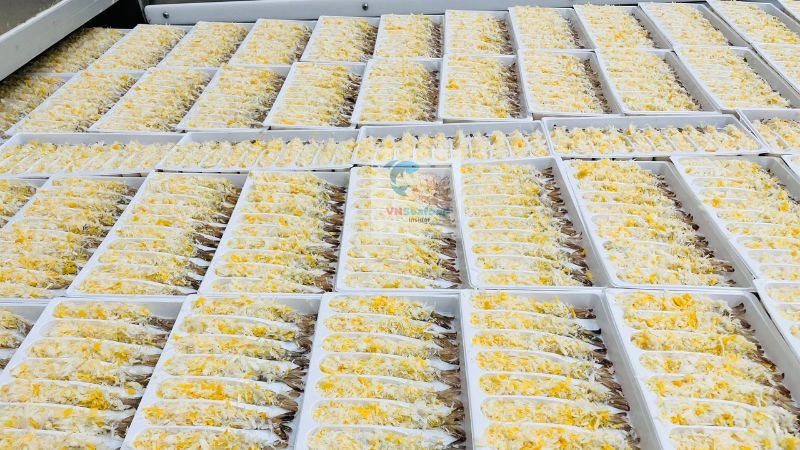
For importers doing the arithmetic: on a $1 million annual shrimp import program, the 10% rate costs $100,000 in duties. The current rate keeps most Vietnam-sourced seafood competitive against alternative origins.
However, shrimp antidumping duties are a separate and important consideration layered on top of the general tariff. These rates are company-specific and change with each administrative review cycle by the US Department of Commerce. Some Vietnamese shrimp exporters currently hold zero or near-zero antidumping rates; others face rates that make US export commercially nonviable. Verify the specific antidumping duty rate for any shrimp supplier you are considering before building your landed cost model.
→ For the latest antidumping duty rates and how they affect your sourcing decisions, see our Vietnam shrimp antidumping duty update.
→ For background on how the US tariff situation evolved and the range of scenarios that played out, see our analysis of US tariff impacts on Vietnam seafood exporters.
EU Market
The EU-Vietnam Free Trade Agreement (EVFTA) provides preferential tariff rates for Vietnamese seafood that meets origin and certification requirements. For most processed shrimp and pangasius products, this creates a meaningful cost advantage over non-EVFTA competitors.
The catch — and it is a meaningful one for tuna buyers — is the EUR1 certificate of origin requirement. To claim the EVFTA preferential rate, exporters must obtain an EUR1 certificate confirming Vietnamese origin. For tuna, this is complicated by IUU (illegal, unreported, and unregulated) fishing concerns: a portion of Vietnam’s tuna catch originates from fishing vessels whose compliance with international standards has not been fully verified, making EUR1 issuance problematic for those supply chains.
The practical implication: buyers targeting the EU market for tuna need to qualify suppliers specifically on their EUR1 issuance capability — not just product quality.
→ For a detailed explanation of the EUR1 bottleneck and its impact on tuna trade, see our article on Vietnam tuna export to the EU.
China Market
There is no significant tariff barrier between Vietnam and China for seafood, and proximity keeps freight costs low. However, Chinese import policy has historically been subject to periodic disruption — suspension of specific facility codes, heightened inspection requirements triggered by political events, or pandemic-era restrictions. Importers sourcing through Chinese distribution channels should maintain supply chain flexibility rather than concentrating all volume through China-destined facilities.
How to Start Importing Seafood from Vietnam
This section is written for importers at the beginning of their Vietnam sourcing journey — or those who want to pressure-test whether their current process is capturing the best available value. It is deliberately practical.
Step 1: Define your product specification before reaching out to anyone
This sounds basic. It is consistently where importers lose the most time.
Vietnamese seafood exporters receive a high volume of inquiry traffic from international buyers. Generic requests — “please send us your price list for shrimp” — get generic responses, if they get any response at all. A specific technical specification immediately signals to a supplier that you are a serious buyer: species, size grade (e.g., 21/25 count for shrimp), processing format (IQF, block frozen, cooked), certifications required, packaging spec, target price range, annual volume estimate, and intended market.
Arrive with this information and you will immediately be prioritized differently.
Step 2: Identify and shortlist suppliers through credible channels
The open internet is a poor sourcing tool for Vietnamese seafood. B2B directories include many non-exporters, brokers, and companies that exist primarily to collect inquiries. Better channels include:
VASEP (Vietnam Association of Seafood Exporters and Producers) maintains a member directory of verified export-eligible companies. VASEP membership is not a quality guarantee, but it is a baseline signal that the company is operating at a commercial export scale.
Industry trade shows — Vietfish in Ho Chi Minh City is Vietnam’s primary domestic seafood trade exhibition, while international shows like Seafood Expo Global (Brussels) and Seafood Expo North America (Boston) attract Vietnamese exporters alongside global buyers.
Specialist sourcing partners with direct presence in Vietnam — such as VNSeafood Insider — offer a more efficient path to verified manufacturing facilities, particularly for buyers who lack the time or local market knowledge to qualify suppliers independently. A credible local partner can pre-screen suppliers, facilitate factory visits, and provide context that no online search can replicate.
Step 3: Verify before you commit any money
The verification step is where many importers skip too quickly in their rush to get product moving. The minimum verification checklist before placing an order:
- Request certificates with unique identification numbers and verify each one directly on the certifying body’s official website
- Ask for laboratory test reports from recent production (within the past six months) covering relevant parameters: microbiological safety, chemical residues, moisture content
- Request references from buyers in your target market — not just any buyer, but buyers operating under the same regulatory framework you face
- Confirm the supplier’s DL-04 code (for EU buyers) or FDA establishment registration (for US buyers) against official databases
Step 4: Sample and run quality checks
No amount of documentation replaces hands-on product evaluation. Request a sample shipment — commercial terms vary, but most established exporters will accommodate sample requests from credible buyers.
The minimum evaluation protocol: weigh the product before and after full thaw to calculate water weight percentage, assess fillet texture and color, and run a cooking test under standard conditions. For shrimp and pangasius specifically, the cooking test will immediately reveal over-treatment issues that paperwork cannot detect.
For larger volume commitments, consider engaging a third-party inspection agency — SGS and Bureau Veritas both have strong Vietnam presence — to conduct pre-shipment inspection at the factory before loading.
Step 5: Negotiate and structure the commercial terms
Standard commercial terms for new importer-exporter relationships in Vietnam:
Incoterms: FOB (Free on Board) Vietnam port is the most common structure, with the buyer arranging freight and insurance. CIF (Cost, Insurance, Freight) is available from larger exporters who have freight forwarding relationships, and may be preferable for buyers without established freight arrangements.
Payment: T/T (telegraphic transfer) with 30% deposit on order confirmation and 70% against copy of bill of lading is the standard for new relationships. For larger programs where both parties want more protection, a Letter of Credit (LC) provides more formal security. Avoid suppliers who require 100% payment upfront before production begins — this is a risk signal.
Lead time: Plan for 3–6 weeks from confirmed purchase order to vessel loading, depending on the product and the supplier’s current production schedule. Build buffer into your supply planning, particularly around Vietnamese holidays (Tet in January/February creates a meaningful production pause across the industry).
See more: Seafood shipping disruption Middle East 2026
Step 6: Build the relationship, not just the transaction
The importers who consistently get the best outcomes from Vietnamese suppliers — reliable supply, priority allocation when raw material is tight, early warning on quality or supply issues — are the ones who invest in the relationship beyond the purchase order.
Practical ways to do this: visit the factory at least once per year, maintain consistent communication through a single relationship contact rather than routing everything through email, provide honest feedback on product quality (positive and negative), and pay on time. These behaviors signal that you are a buyer worth prioritizing.
Vietnamese seafood supply chains are tighter than they appear on paper. When shrimp disease hits a farming region or pangasius fingerling supply runs short, suppliers allocate available production to buyers they trust. Being that buyer is a strategic advantage that no price negotiation can substitute.
→ To start the supplier identification process, see our list of the largest seafood exporters in Vietnam or submit a sourcing inquiry through our sourcing request form.
Frequently Asked Questions
What is the minimum order quantity (MOQ) when importing seafood from Vietnam?
For most product categories, the practical minimum is one 20-foot refrigerated container, which typically holds 10–12 metric tons depending on product density and packaging format. Some exporters will accommodate smaller trial orders from new buyers — this is worth negotiating explicitly during the qualification stage. Expect a price premium for sub-container quantities.
How long does sea freight take from Vietnam to my market?
Transit times vary significantly by destination. US West Coast ports (Los Angeles, Long Beach) are typically 18–22 days. East Coast US ports run 28–35 days via Suez or the Panama Canal. Northwest European ports (Rotterdam, Hamburg) are 25–32 days. Japan and South Korea are 5–10 days. These are vessel transit times only — add 3–5 days for port handling and customs clearance at destination.
See more: Rising Freight Costs Are Reshaping the Vietnam Seafood Supply Chain in 2026
Which certifications should I require as a baseline?
At minimum: HACCP certification for the processing facility (BRC could be a replacement for higher level), plus the market-specific certification relevant to your distribution channel. For US retail or food service, BAP is standard. For EU retail, GlobalG.A.P. and potentially IFS or BRC. For sustainability-conscious buyers in any market, ASC is the gold standard. Always verify certification numbers directly — do not rely solely on PDFs provided by the supplier.
Is it still cost-competitive to import Vietnamese seafood to the US given the current tariff situation?
Yes, for most product categories. At the current 10% reciprocal tariff, Vietnam remains materially more competitive than the other countries thanks to low labour cost and production efficiency. The exception to watch is shrimp, where company-specific antidumping duties can vary significantly and need to be verified for each supplier individually.
How do I protect myself from receiving oversoaked or poor-quality product?
Three layers of protection: first, specify maximum moisture content and phosphate limits explicitly in the purchase contract, not just verbally. Second, require laboratory test reports covering these parameters from recent production. Third, run your own thaw and cook test on samples before committing to commercial volume. Price significantly below market benchmarks is almost always a signal that something in the quality picture does not add up — treat it as a prompt to investigate, not a buying opportunity.
How do I find verified Vietnamese seafood suppliers?
The most reliable channels are VASEP’s member directory and specialist local sourcing partners with direct factory relationships. VNSeafood Insider works directly with Vietnamese plants across multiple species and can facilitate competitive offers based on your specific product requirements. Start with our sourcing request form.
Conclusion
Vietnam’s seafood export industry offers a genuinely compelling sourcing proposition: scale, species diversity, year-round production, a maturing certification ecosystem, and pricing that remains competitive against alternatives even in the current tariff environment.
The importers who get the most out of it are those who invest the time to understand how the system works before they commit capital. That means understanding which certifications matter for your market, where quality risks concentrate, how to read the tariff landscape for your specific product, and how to build supplier relationships that prioritize you when supply is tight.
Use the species guides below to go deeper on the product categories most relevant to your sourcing program:
→ Vietnam Shrimp Export Guide
→ Vietnam Pangasius Importer’s Guide
→ Vietnam Tilapia Sourcing Guide
→ Vietnam Tuna Export Guide
→ Vietnam White Fish Sourcing Guide
Ready to connect with verified Vietnamese seafood suppliers? Submit your sourcing inquiry here
Last updated: April 2026. Export statistics and tariff rates are subject to change. VNSeafood Insider updates this guide regularly to reflect current market conditions.
