
Why Tilapia Fish from Vietnam Is Gaining Global Market Share
The global tilapia market is projected to reach roughly $20 billion by 2030. That’s a lot of fish to go around — and a lot of room for new suppliers to carve out space. Vietnam is doing exactly that.
Vietnam’s Emergence as a Serious Tilapia Fish Exporter
Here’s the number that turns heads: Vietnam tilapia fish exports hit approximately $99 million in 2025, a 141% increase over 2024. For a country that wasn’t even on most tilapia buyers’ radar five years ago, that’s a remarkable leap. Vietnam already had the aquaculture infrastructure — roughly 1.3 million hectares of farming area — the processing capacity, and the cold chain logistics from decades of pangasius and shrimp exports. Tilapia was, in many ways, the obvious next product to scale.
Why US and European Buyers Are Switching to Tilapia Fish from Vietnam
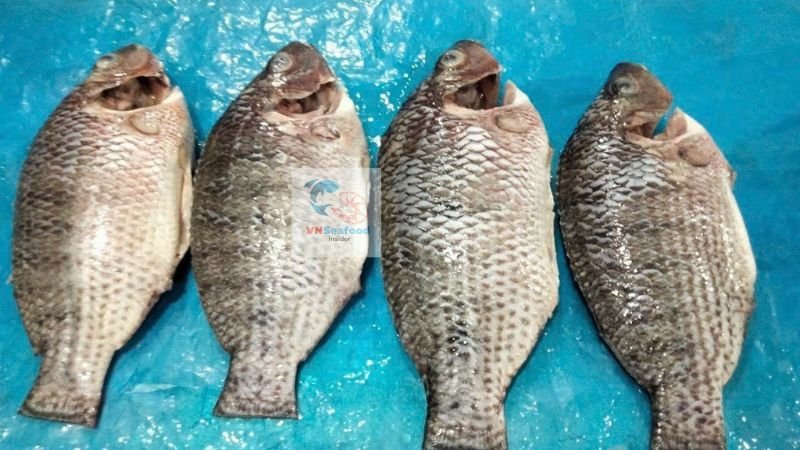
The reasons are pragmatic, not sentimental. US buyers, in particular, needed alternatives after tariffs on Chinese tilapia made that origin commercially painful. But beyond tariffs, frozen tilapia fillets from Vietnam arrived with competitive pricing, familiar processing formats (skinless, boneless, retail-ready packs), and factories already certified to export to demanding markets. European buyers, meanwhile, appreciate that Vietnam’s FTA agreements — notably EVFTA — offer tariff advantages that Chinese and Indonesian product simply don’t enjoy.
For a deeper look at what’s driving this shift, we covered the dynamics in our analysis of why US buyers are switching to tilapia fish from Vietnam.
Vietnam Tilapia as a White Fish Alternative Amid Global Supply Disruptions
Let’s be honest — the white fish category has been turbulent. Cod prices remain elevated. Pollock supplies fluctuate with geopolitics. Pangasius faces its own demand cycles. In this environment, tilapia fish from Vietnam has become a practical white fish alternative for foodservice operators and retailers looking for consistent supply at a manageable price point.
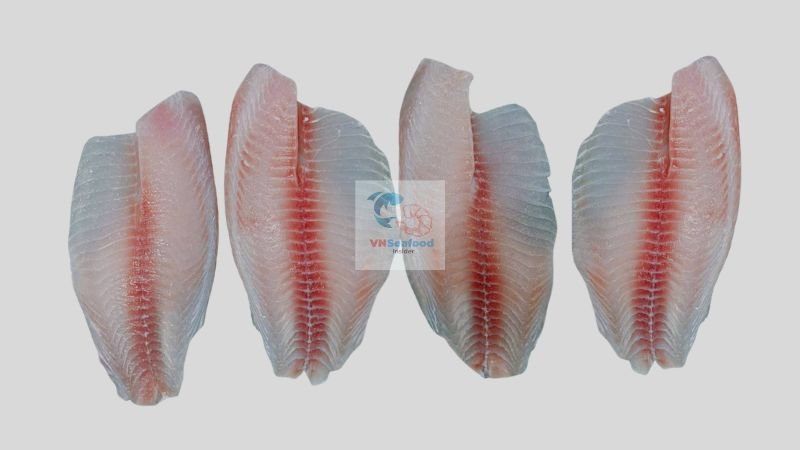
Vietnam’s ability to deliver both whole fish and value-added fillet formats gives buyers flexibility that single-product origins can’t match. We explored this positioning further in Vietnam tilapia fish: rising white fish alternative.
The China Tariff Shift — Why Vietnam Tilapia Fish Is the Beneficiary
If there’s a single catalyst behind Vietnam’s tilapia breakout, it’s what happened to Chinese tilapia in the US market. Trade policy doesn’t just create winners and losers — it reshuffles entire supply chains overnight.
Chinese Tilapia US Tariff at Extreme High — What It Means for Global Buyers
The US tariff on Chinese tilapia has reached an extreme level — and even higher when you stack anti-dumping duties and Section 301 tariffs together. For US importers, that turns a $2.50/lb fillet into something approaching $4.xx/lb landed. With that math, Chinese tilapia simply stops making commercial sense for most volume buyers. The details and implications are covered in our piece on Chinese tilapia US tariff.
How the US Tariff on Chinese Tilapia Opened the Door for Vietnam
Nature — and commerce — abhor a vacuum. When Chinese tilapia became prohibitively expensive for US buyers, sourcing teams started calling Vietnam. And Vietnam answered. In the first eight months of 2025 alone, Vietnam’s tilapia fish exports to the US surged, with roughly 70% of the country’s total tilapia value heading stateside.
Regular tilapia (not red tilapia) exports jumped 359% year-over-year. That’s not gradual growth. That’s a market rerouting in real time.
Vietnam’s Competitive Position Against Other Tilapia Origins Post-Tariff
Vietnam isn’t the only alternative to China, of course. Indonesia, Honduras, Colombia, and Ecuador all compete in the tilapia space. But Vietnam brings a combination that’s hard to beat: large-scale processing capacity, established cold chain logistics, competitive labor costs, and — crucially — experience meeting the food safety and documentation requirements of US and EU regulators.
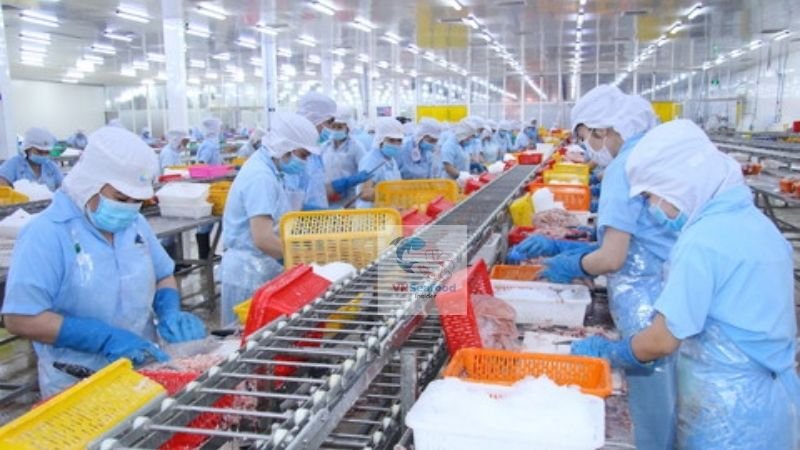
When a buyer needs 10 containers per month of consistent fillet quality with full traceability, the list of origins that can actually deliver gets very short. Vietnam is on it.
Vietnam Tilapia Farming — What Every Importer Needs to Know
Behind every good fillet is a farm, and understanding how tilapia is farmed in Vietnam helps you evaluate whether a supplier’s claims about quality and sustainability actually hold up.
Where and How Tilapia Fish Is Farmed in Vietnam
Tilapia farming in Vietnam concentrates in the Mekong Delta provinces and parts of central and northern Vietnam where freshwater and brackish water conditions are ideal. Farms range from household pond operations of a few hectares to industrial-scale cage culture systems.
The government, alongside international development partners, is actively pushing to scale production toward 1.2 million tonnes — a figure that would generate roughly $1.25 billion in revenue and directly benefit tens of thousands of farming households and processors.
How Farm-Gate Prices for Vietnam Tilapia Fish Doubled in 2025
This is something every buyer needs on their radar. Farm-gate tilapia prices in Vietnam roughly doubled in 2025, driven by surging export demand that outpaced the country’s still-growing supply base.
When export volumes jump 141% in a single year, farms gain pricing power. It’s basic economics, but it has real implications for your cost modeling. We analyzed the pricing dynamics in detail in Vietnam tilapia farming 2025 — prices doubled.
Farming Certifications and Sustainability Standards to Require
If you’re importing to the US or EU, certification isn’t optional — it’s table stakes. Look for farms and processors with ASC, BAP certification. Vietnamese authorities are actively tightening controls on seed quality and farming zone management.

For buyers, this means the certification landscape is improving, but you still need to verify independently. Don’t rely solely on what a supplier tells you — request audit reports and check validity dates.
Vietnam Tilapia Fish Export Performance and Market Outlook
Numbers tell stories that marketing materials can’t. Here’s what the data says about where Vietnam tilapia fish stands and where it’s heading.
Key Export Statistics for Tilapia Fish from Vietnam
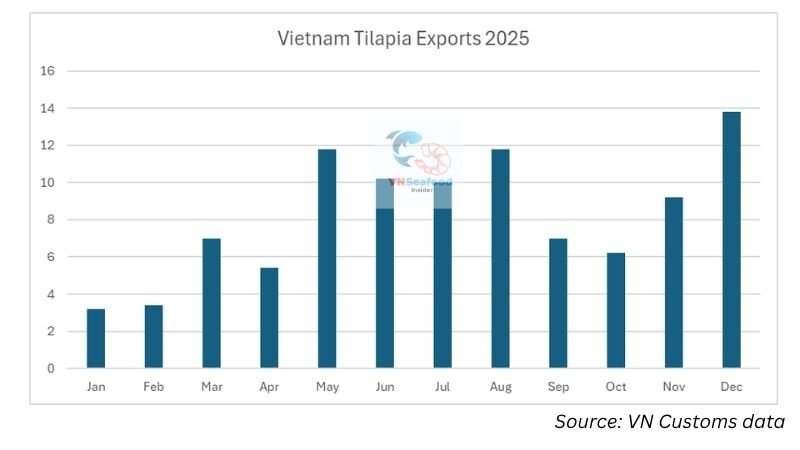
Full-year 2025 exports reached approximately $99 million — the highest in at least five years. Frozen fillets and processed tilapia meat accounted for about 61% of value (~$61 million), confirming the shift toward value-added products.
Top Destination Markets for Vietnam Tilapia Exports
The United States dominated in 2025, absorbing 60–70% of Vietnam’s total tilapia export value. Fillet exports to the US alone reached an estimated $40 million.
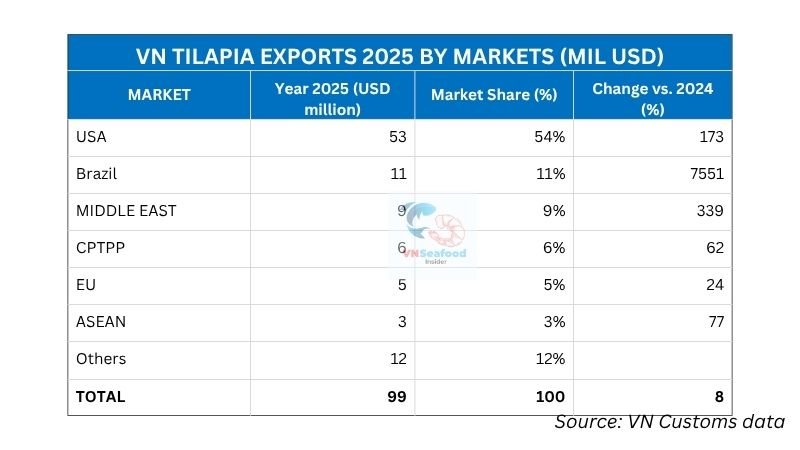
Brazil emerged as a surprise growth market — already a major tilapia producer itself, Brazil increasingly imports Vietnamese tilapia for processing, F&B, and re-export. By Q1 2026, Brazil had actually overtaken the US as Vietnam’s largest tilapia buyer.
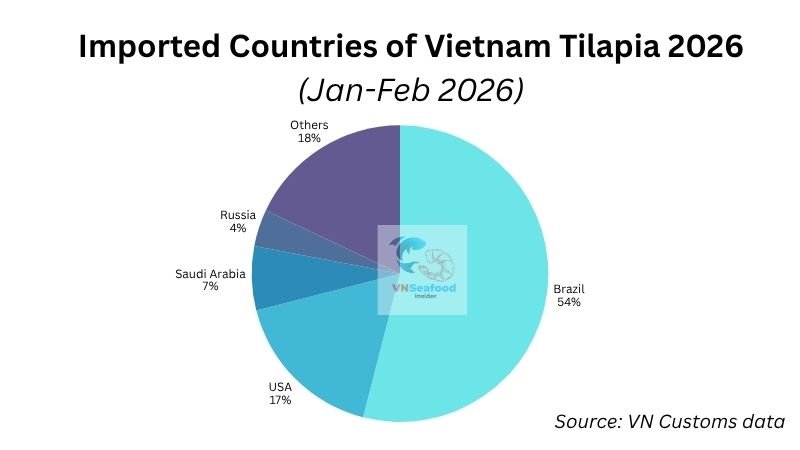
The EU, Middle East, and select Asian markets round out the destination mix, with FTA tariff advantages giving Vietnamese product a competitive edge.
Export Challenges — The Santa Catarina Import Ban and TiLV Disease Concerns
Growth doesn’t come without headaches. Brazil’s Santa Catarina state imposed an import ban on certain tilapia products due to TiLV (Tilapia Lake Virus) concerns — a move that disrupted shipments and forced Vietnamese exporters to navigate new regulatory requirements.
TiLV remains a watchpoint for the industry globally, and buyers should ask suppliers directly about their disease monitoring and biosecurity protocols. We covered the Santa Catarina situation in Vietnam tilapia export challenge — Santa Catarina ban.
Vietnam Tilapia Price Trends 2026 — What Importers Should Expect
Expect tilapia prices from Vietnam to remain firm through 2026. Farm-gate prices have already adjusted upward, processing costs are stable but not declining, and demand continues to outpace supply growth.
That said, as more farming area comes online and yields improve, the supply-demand balance should gradually ease. Our forward-looking analysis is available in tilapia price trends 2026.
Product Quality — How to Evaluate Frozen Tilapia Fillets from Vietnam
This is where sourcing gets real. A competitive price means nothing if your containers arrive with quality issues that trigger customer complaints or regulatory holds.
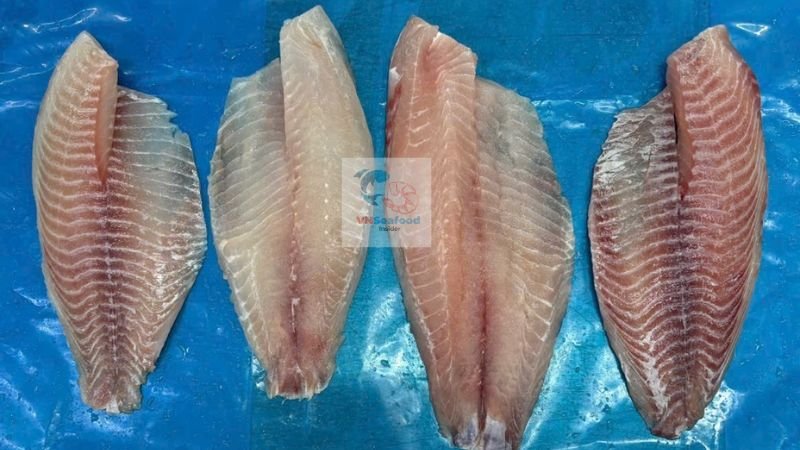
Tilapia Fillet Grades and Processing Formats Available from Vietnamese Suppliers
Vietnamese processors offer the full range: skinless boneless fillets (the volume leader), skin-on fillets, whole round/gutted fish, portioned cuts, and red tilapia for niche markets. Standard sizes run 3–5 oz and 5–7 oz. Packing formats include retail-ready 500g–1kg bags and bulk 10kg cartons. Most factories can customize packing and labeling to buyer specifications.
How to Identify High-Quality Frozen Tilapia Fillets Before You Commit
Before committing to volume, request samples and evaluate: flesh color consistency (uniform white to pinkish-white), moisture content (excessive glazing is a red flag), texture after thawing, and absence of off-odors.
Check for proper IQF separation — fillets shouldn’t be frozen into blocks unless that’s what you ordered. Our quality evaluation guide goes deeper: how to identify high-quality frozen tilapia fillets.
The Most Common Quality Issues with Vietnam Tilapia fish and How to Avoid Them
The usual suspects: over-glazing (adding water weight), inconsistent sizing within a carton, bruising or bloodline discoloration, and incomplete bone removal. Mitigation is straightforward — specify net weight after deglaze in your contract, require third-party inspection (SGS, Bureau Veritas), and visit the factory if your volume justifies the trip. Trust but verify. Always verify.
Top Tilapia Producers in Vietnam — Who Is Actually Exporting
Overview of Vietnam’s Leading Tilapia Processing and Export Companies
Vietnam’s tilapia processing sector includes both established seafood conglomerates that added tilapia to their pangasius lines and newer companies that built specifically around tilapia demand.
The top exporters typically operate EU- and FDA-registered facilities with HACCP, BRC, or IFS certification. We profiled the key players in top 5 tilapia producers in Vietnam.
Key Certifications and Documentation to Verify Before Placing an Order
At minimum: HACCP, FDA facility registration (for US imports), EU approval number (for EU imports), health certificates from Vietnam’s NAFIQAD, and relevant farming certifications (GlobalGAP, ASC, or BAP).
For the US market specifically, ensure the supplier can provide Certificates of Origin and any documentation needed for customs clearance under current duty structures.
How to Import Vietnam Tilapia Fish — Avoiding Costly Mistakes
Importing seafood from a new origin always involves a learning curve. Here’s how to flatten it.
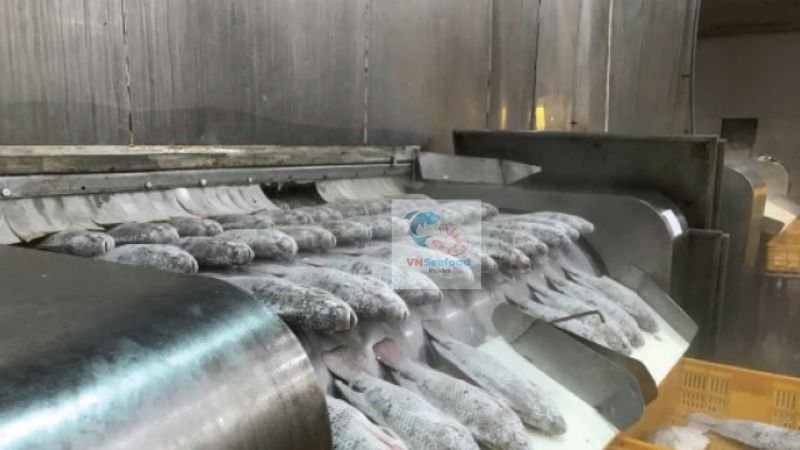
The 5 Most Common Mistakes When Importing Tilapia from Vietnam
We’ve seen buyers stumble on the same issues repeatedly:
(1) not specifying net weight vs. gross weight clearly
(2) skipping pre-shipment inspection on first orders
(3) assuming all Vietnamese suppliers have the same quality standards
(4) underestimating lead times during peak season
(5) failing to confirm regulatory documentation before the container ships.
Each of these is avoidable with proper preparation. Our detailed breakdown: 5 common mistakes when importing tilapia from Vietnam.
Product Specification, MOQ, and Commercial Terms to Negotiate
Typical MOQs start at one 20ft container (10–12 MT). Payment terms for new buyers usually involve 30% T/T deposit with 70% against copy of B/L, though L/C at sight is common for larger volumes.
Negotiate specifications down to the detail level — fillet size range, glaze percentage, packing configuration, labeling language, and shelf life requirements. Put everything in writing. Verbal agreements don’t survive disputes.
Step-by-Step Process for Your First Tilapia Import from Vietnam
The sequence:
Identify 3–5 potential suppliers → request samples and documentation → evaluate quality and verify certifications → negotiate terms and sign contract → arrange pre-shipment inspection → confirm shipping logistics and documentation → receive and inspect goods at port → build the relationship from there.
Frequently Asked Questions About Vietnam Tilapia Fish
Is tilapia fish from Vietnam safe and legal to import to the US and EU?
Yes. Vietnamese tilapia processing facilities that are FDA-registered (US) or EU-approved can legally export to both markets.
Vietnam’s food safety authority (NAFIQAD) issues health certificates for each shipment. As with any origin, buyer due diligence on individual suppliers remains essential.
How does Vietnam tilapia fish compare to Chinese tilapia in quality and price?
Quality is comparable when sourced from reputable processors — same species, similar processing techniques. On price, Vietnamese tilapia is now significantly cheaper for US buyers than Chinese product once tariffs are factored in.
Even before tariffs, FOB prices from Vietnam are competitive with most origins.
What certifications should I require from a Vietnam tilapia supplier?
HACCP as a baseline. BRC or IFS for retail-grade product. BAP or ASC at the farm level for sustainability-conscious buyers. FDA registration for US imports, EU approval for European markets. Always verify — don’t just accept certificates at face value.
What is the current price range for frozen tilapia fillets from Vietnam?
As of mid-2026, FOB prices for frozen tilapia fillets from Vietnam typically range from $2.XX–$3.XX/kg depending on size, grade, glaze percentage, and order volume. Prices have firmed since 2024 and are expected to remain stable through late 2026.
How do I find verified tilapia producers and exporters in Vietnam?
Start with VASEP’s member directory. Cross-reference with FDA’s facility registration database and EU approved establishment lists.
You also can attend the seafood tradeshow Vietfish (Ho Chi Minh City) or contact VNSF Insider – the sourcing agent with on-the-ground presence. That’s literally what we’re here for.
The tilapia story from Vietnam is still being written. But the data, the infrastructure, and the market dynamics all point in one direction. If you’re sourcing white fish protein at scale, Vietnam deserves a serious look — and this guide is your starting point.
