
Vietnamese White Clams Market Overview: Export Data and Key Destinations
Before diving into the product itself, it helps to understand the bigger picture. The Vietnamese clam export market has been growing steadily, and the numbers tell a compelling story for importers looking at long-term supply stability.
2025–2026 Export Performance
According to Vietnam Customs data, total clam export value in 2025 reached 120 million USD — a figure that reflects both rising global demand and Vietnam’s expanding production capacity. In the first four months of 2026 alone, exports already topped 38 million USD, marking a 2% increase compared to the same period in 2025.
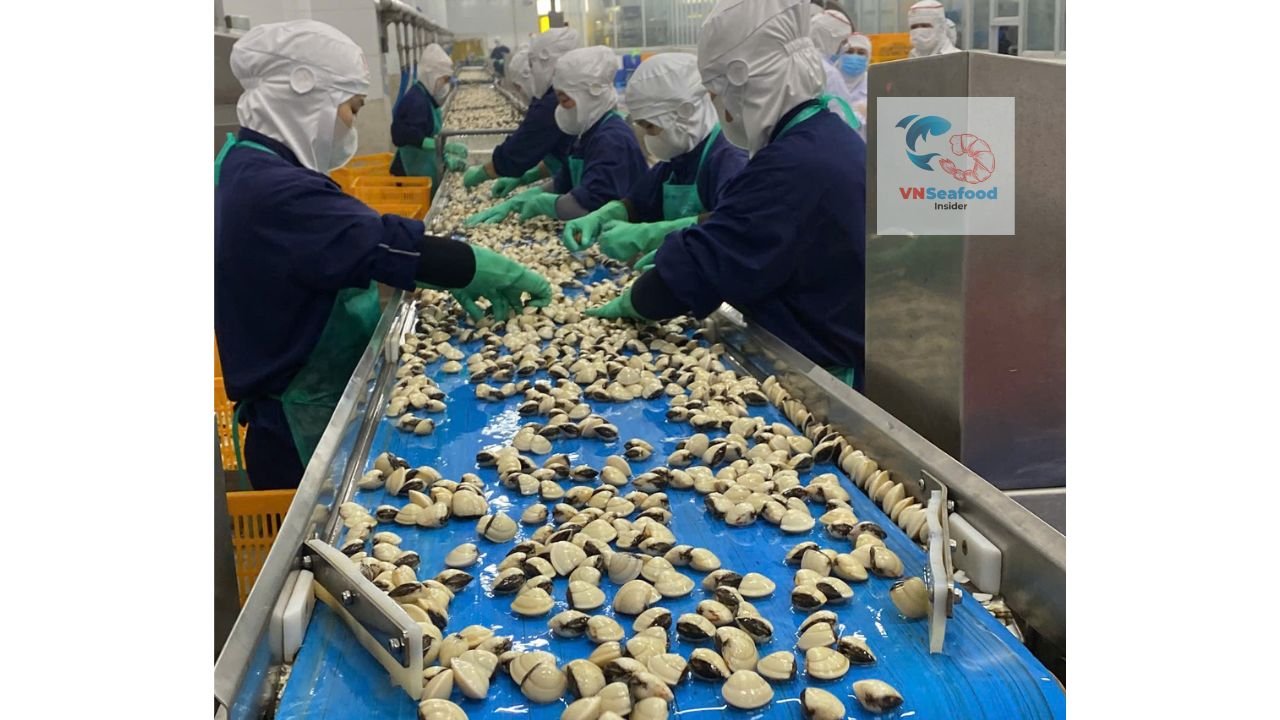
That 2% might sound modest on paper. But in a sector where weather, spawning cycles, and global logistics all play unpredictable roles, consistent year-over-year growth signals something important: the supply chain is maturing. Factories are more efficient. Farmers are more experienced. And buyers keep coming back.
Top Import Markets for Vietnamese White Clams
So where are all these clams going?
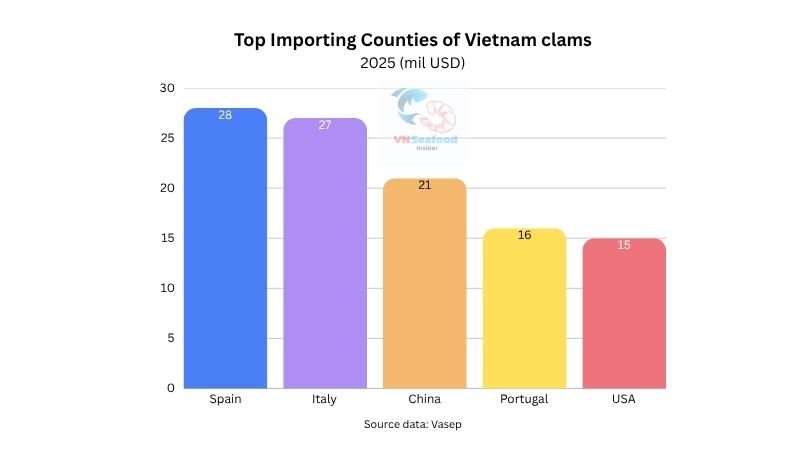
The European Union remains the dominant destination — and it’s not even close. In 2025, the top five markets by value were:
- Spain — 28 million USD
- Italy — 27 million USD
- China — 21 million USD
- Portugal — 16 million USD
- United States — 15 million USD
Spain and Italy alone accounted for nearly half of total exports. That’s no surprise if you know Mediterranean food culture — clams are a kitchen staple there, from spaghetti alle vongole to arroz con almejas. Portugal follows a similar pattern.
What’s interesting is China’s position at number three. The Asian seafood market has been expanding its appetite for premium shellfish, and Vietnamese white clams fit that demand nicely.
For importers in these regions, the takeaway is straightforward: you’re sourcing from a proven, high-volume origin with an established track record in your market.
What Makes Vietnamese White Clams (Meretrix lyrata) Stand Out
Numbers are one thing. But what actually makes this clam worth importing over alternatives from other origins? Let’s talk about the product itself.
Species and Quality Characteristics
The species we’re talking about is Meretrix lyrata — commonly known as the Vietnamese white clam or nghêu trắng locally. It’s a bivalve that thrives in the brackish tidal flats along Vietnam’s coastline, and it has several characteristics that importers and end-users genuinely appreciate.
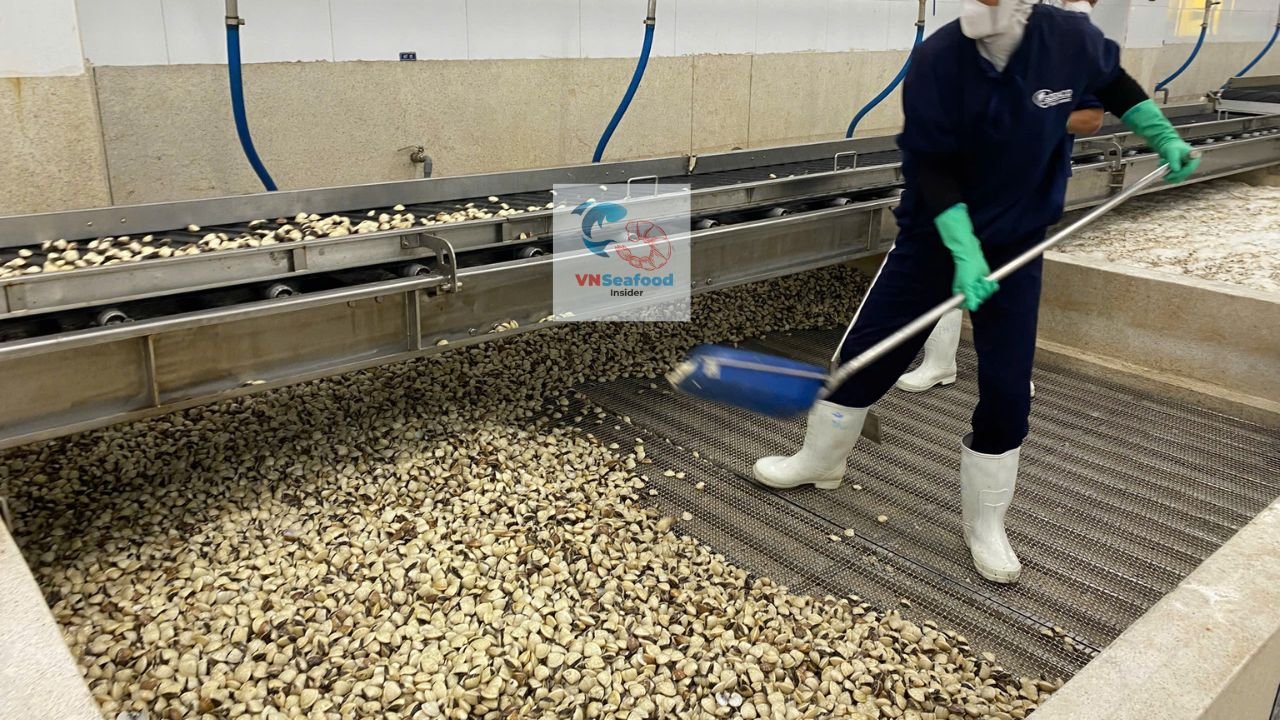
First, the meat. Vietnamese white clams are known for their thick, white flesh — not the grayish, thin meat you sometimes see with other species. The flavor profile is clean, naturally sweet, and carries that satisfying briny note without being overly fishy. Nutritionally, they’re protein-dense and low in fat, which checks a lot of boxes for health-conscious consumers.
Second, consistency. Because farming practices have been refined over decades, the product arriving at processing facilities tends to be remarkably uniform in size and quality. That matters when you’re filling container orders.
International Certifications
Here’s where it gets really interesting for quality-focused importers. Clams from Ben Tre province — Vietnam’s largest clam-producing region — have earned MSC certification (Marine Stewardship Council). That’s a globally recognized standard for sustainable fisheries, and it’s not handed out lightly.
Additionally, some farming areas, including parts of Tien Giang province, have achieved ASC certification (Aquaculture Stewardship Council), making them among the first clam farms in the world to hold this standard.
For buyers selling into EU or North American retail, these certifications aren’t just nice to have — they’re increasingly non-negotiable.
Where Vietnamese White Clams Are Farmed
Understanding where your product comes from isn’t just trivia. It directly affects quality, availability, and certification status. Vietnam’s clam farming regions stretch along the entire coastline, but a few areas dominate production.
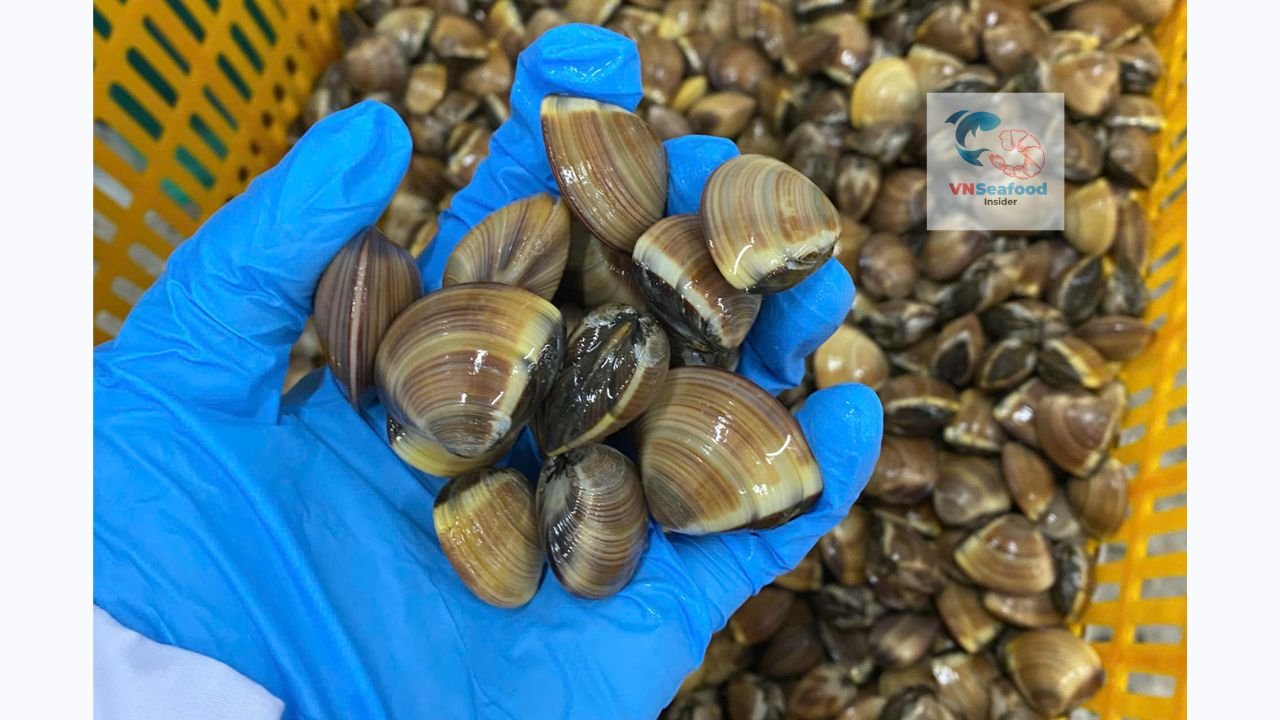
Northern Farming Regions
In the north, Nam Dinh, Ninh Binh, and Thanh Hoa provinces all have significant tidal flat operations. These areas benefit from nutrient-rich river sediment flowing into coastal zones, creating productive feeding grounds for clams.
Northern farms tend to experience cooler water temperatures during winter months, which can slow growth rates slightly but also produces clams with firm texture. The farming here is extensive — meaning clams grow in natural tidal environments with minimal artificial intervention.
While these northern provinces contribute meaningful volume to the national harvest, they’re generally less prominent in the export supply chain compared to their southern counterparts. Most northern production serves domestic consumption, though that’s gradually shifting as processing capacity expands.
Mekong Delta: The Country’s Clam Capital
If Vietnam’s clam industry has a heartbeat, it pulses in the Mekong Delta — specifically in Ben Tre and Tien Giang provinces. This is the thủ phủ (capital) of Vietnamese clam production, and it’s where the bulk of export-grade product originates.
The geography here is almost purpose-built for clam farming. Warm tropical waters, extensive tidal flats, abundant natural phytoplankton, and a mix of fresh and saltwater from Mekong River outflows create ideal growing conditions year-round.
At VNSeafoodInsider, the white clams (Meretrix lyrata) we source come from these two provinces. The combination of natural advantages, experienced farmers, and proximity to certified processing facilities makes this region the gold standard for Vietnam clam sourcing.
It’s worth noting that Ben Tre’s clam cooperatives have been operating for decades. This isn’t a new industry figuring things out — it’s a mature supply ecosystem with deep institutional knowledge.
See more: Top 20 Biggest Seafood Companies in Vietnam
Vietnamese White Clam Lifecycle: From Larvae to Harvest
Here’s something most importers never think about, but probably should: what happens before the clam reaches the factory? Understanding the clam lifecycle helps you make sense of seasonal availability, size variations, and why pricing fluctuates when it does.
Two-Stage Life Cycle
The lifecycle of Meretrix lyrata unfolds in two distinct stages. First, there’s the planktonic larval phase — tiny free-floating organisms drifting with ocean currents near the water’s surface. Think of it as the clam’s brief adventure as a wanderer.
Then comes the benthic phase, where larvae metamorphose and settle onto the sandy bottom, burrowing into sediment. From this point forward, the clam lives its entire life buried in sand on tidal flats, filter-feeding on phytoplankton and organic particles carried in by tidal flows. Not the most exciting existence, perhaps, but remarkably efficient.
Spawning Season and Reproduction
Peak spawning season runs from March through August each year, when water temperatures and conditions trigger mass reproductive events. Here’s how it works: male and female clams simultaneously release sperm and eggs into the surrounding seawater, where external fertilization occurs.
The numbers are staggering. A single mature female can release 3 to 8 million eggs per spawning event. Of course, the vast majority won’t survive to adulthood — but the sheer volume ensures enough larvae settle successfully to sustain both wild and farmed populations.
This spawning window directly influences when seed clams become available for stocking on farming grounds, which in turn affects harvest timing 16–21 months later.
Growth Timeline to Harvest Size
From fertilization to commercial harvest size, the total growth period ranges from approximately 16 to 21 months — roughly 1.5 to nearly 2 years. Here’s how that timeline breaks down:
- ~9 to 11 days (0.3 months): Fertilized egg develops through larval stages, metamorphoses, and settles to the bottom.
- 4 to 5 months: Post-settlement juveniles grow from tiny spat into fingernail-sized seed clams (called nghêu giống hạt lựu locally — “pomegranate seed clams,” which is a wonderfully descriptive name).
- 12 to 16 months: Seed clams are stocked onto tidal farming grounds and grown to harvest size of 40 to 70 pieces per kilogram.
Growth speed depends heavily on water temperature, salinity levels, and phytoplankton density at the farming site. A good year with favorable conditions pushes clams toward the 16-month end. A tough year with storms or salinity disruptions stretches things closer to 21 months.
For importers, this means supply planning needs to account for biological realities, not just factory capacity.
Vietnamese White Clam Pricing: Raw Material Cost
Let’s talk about money. Pricing transparency builds trust, and at VNSeafoodInsider, we believe importers should understand cost structures — starting at the source.
Current Raw Material Prices (2026)
At the farm gate level, raw material prices for Vietnamese white clams (harvest size: 40–70 pieces/kg) currently range from 27,000 to 40,000 VND per kilogram (approximately 1.05–1.55 USD/kg).
That range reflects variations in size grading, season, and local supply-demand dynamics. Smaller counts (fewer, larger clams per kilo) command higher prices. Prices also tend to firm up during periods between harvests or after weather events that affect farming areas.
This raw material cost represents just one component of the final FOB or CIF pricing that importers see — processing, labor, packaging, certification compliance, logistics, and margin all add layers. But knowing the starting point helps you evaluate whether a quoted price makes sense.
Vietnamese White Clam Processing: From Harvest to Export-Ready Product
This is where things get technical — and where quality is truly made or lost. The clam processing workflow might look straightforward on paper, but every step involves decisions that affect what arrives at your port.
Initial Quality Screening
Before raw clams even enter the processing facility, incoming lots are tested for survival rate, shell condition, and sand content. Only batches that pass this initial screening move forward into production. This single gate filters out a significant volume of substandard harvest — and it’s the first line of defense for your product quality.
Purging and Washing
Accepted clams go into saltwater aeration tanks for 2 to 3 hours. This purging step does two things: it allows clams to expel residual sand from their digestive systems, and it helps them stabilize physiologically before further handling.
After purging, clams go through two rounds of clean-water washing. These washing stages double as another sorting opportunity — workers and line equipment identify and remove any clams that don’t meet standards as they move along the processing line.
The Critical Pre-Steaming Step
Here’s a detail that separates export-grade processing from everything else — and frankly, it’s something most people outside the industry have never heard of.
If you buy clams at a local market and boil them at home, the shells pop open. That’s normal for home cooking. But export-quality cooked clams arrive with shells firmly closed. How?
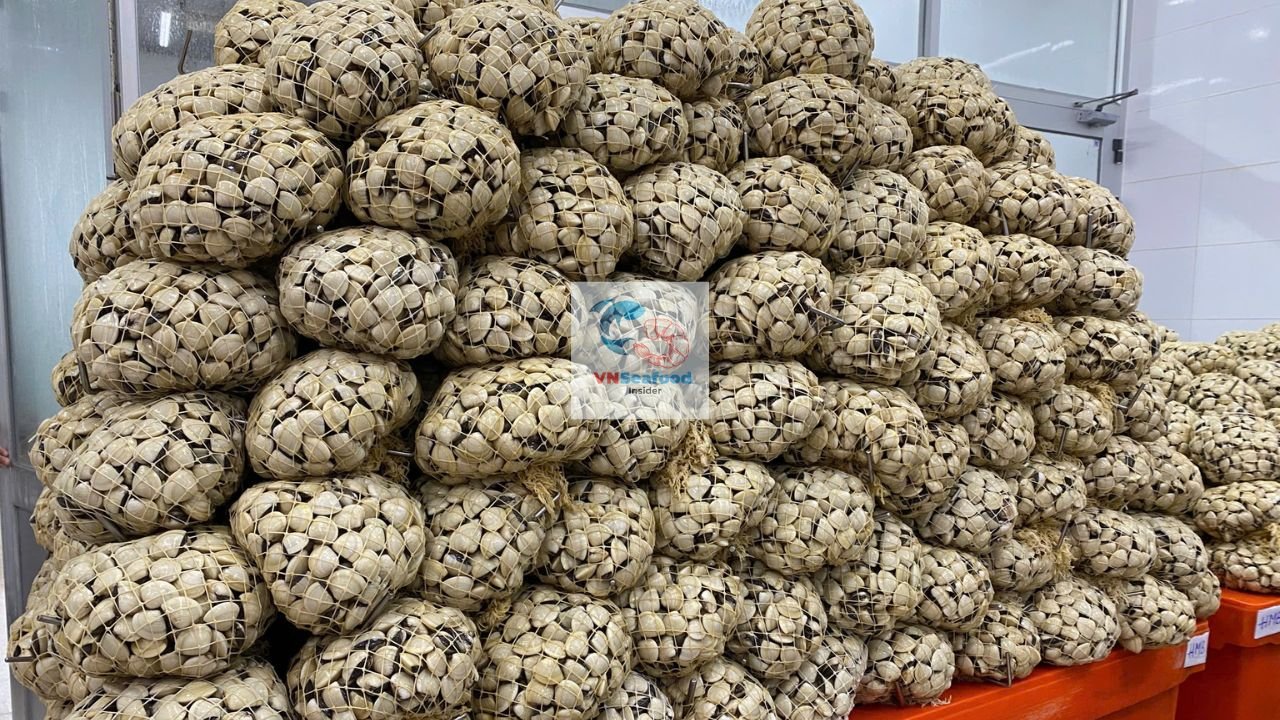
Before steaming, clams are packed tightly into mesh bags. This isn’t just for handling convenience. The tight packing physically prevents shells from gaping open during the cooking process, which directly affects both visual appearance and moisture retention in the finished product.
This is also the stage where workers perform a final manual sort — removing dead clams, cracked shells, gaping specimens, or anything with an off-smell. It’s hands-on, detail-oriented work, and it matters enormously.
Steaming, Cooling, and Packing
Steaming runs for 3 to 4 minutes at controlled temperatures — enough to cook the meat through without making it rubbery. Immediately afterward, clams go into an ice bath for 15 to 30 minutes, rapidly dropping the core temperature. This quick chill locks in texture, prevents bacterial growth, and prepares the product for final packing.
One more thing worth mentioning: in a typical white clam harvest batch arriving at the factory, brown-shell clams make up roughly 10–15% of total volume. How your supplier handles that ratio — and whether they disclose it — tells you a great deal about their transparency and integrity.
How to Identify High-Quality Vietnamese White Clams
Whether you’re evaluating samples or inspecting a landed shipment, knowing what to look for saves time, money, and difficult conversations.
Key Quality Indicators for Importers
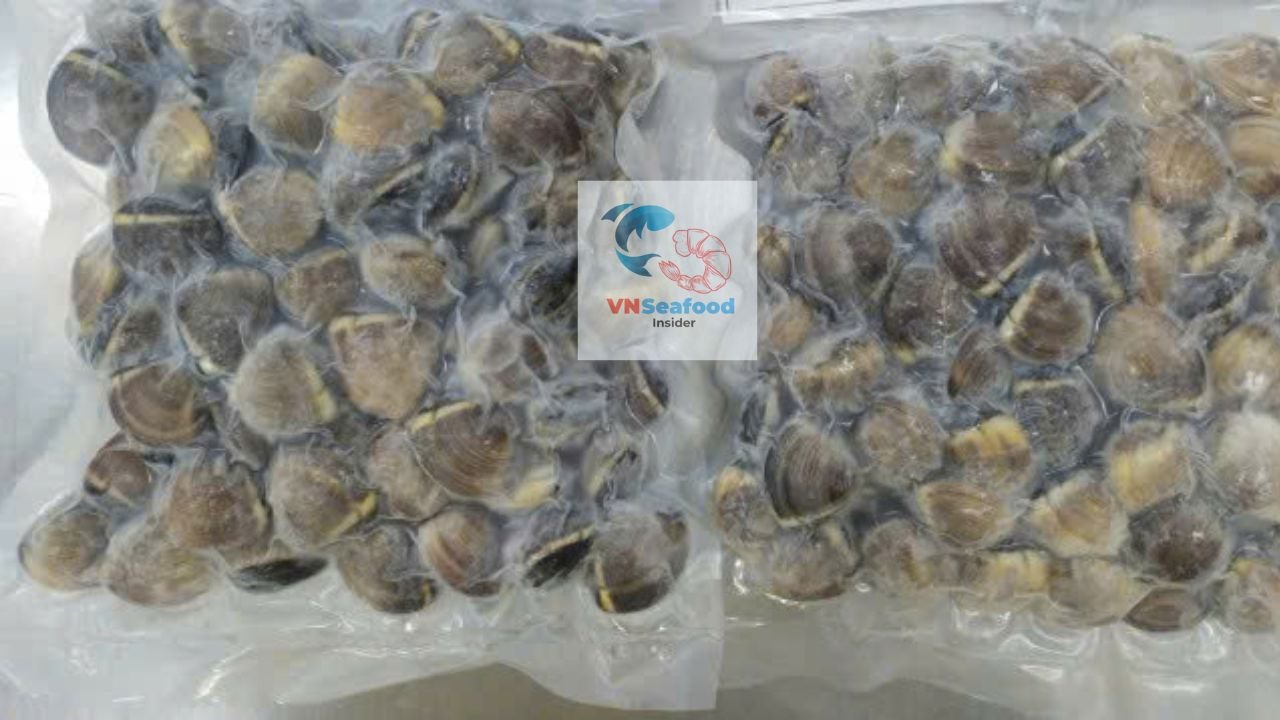
Good clam quality comes down to a few clear indicators:
- Intact shells — no cracks, chips, or breaks
- No off-odors — fresh clams smell like the ocean, nothing more
- Sand-free — properly purged and washed product should have zero grit
- Uniform sizing — consistent piece count per kilogram within each grade
These seem simple. They are simple. But you’d be surprised how often one or more of these basics gets compromised when suppliers cut corners.
VNSF Insider’s QC Process
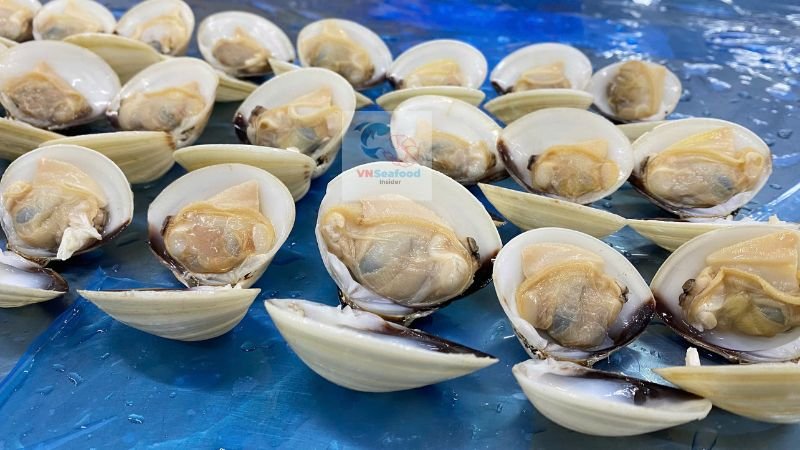
At VNSeafoodInsider, our QC team doesn’t just inspect the production line. We also run cooking tests on samples from every batch — essentially preparing the product as an end consumer would. Only product that passes every criterion across all inspection stages gets cleared for shipment.
It’s an extra step. It takes time. But it’s the difference between knowing your product is good and hoping it is.
Popular Culinary Uses for Vietnamese White Clams
Understanding how your buyers’ customers actually use the product helps you position it effectively and select the right processing specifications.
Vietnamese white clams are wonderfully versatile in the kitchen. Common preparations include:
- Steamed clams — served simply with butter, garlic, and white wine (classic European style)
- Lemongrass-steamed clams — an Asian-style preparation with lemongrass, chili, and herbs that’s become increasingly popular globally
- Clam pasta — spaghetti alle vongole and similar dishes remain a massive volume driver in Mediterranean markets
- Clam chowders and soups — particularly relevant for North American foodservice
- Stir-fried clam meat — using shucked meat in noodle dishes, rice bowls, and Asian fusion cuisine
The thick, white meat and clean flavor of Meretrix lyrata perform well across all these applications — which partly explains why demand spans so many different markets and cuisines.
Sourcing Vietnamese White Clams: Next Steps for Importers
If you’ve made it this far, you now have a solid foundation — market context, species knowledge, processing understanding, and quality benchmarks. That’s more than most buyers start with, and it puts you in a stronger position to evaluate suppliers and make informed decisions.
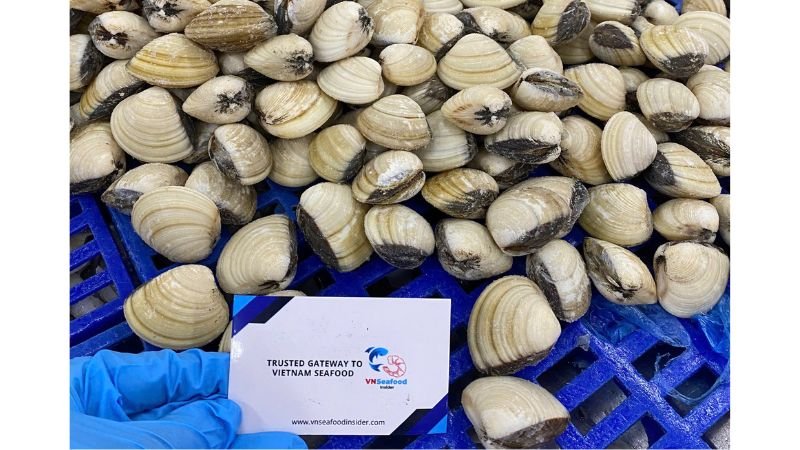
At VNSeafoodInsider, we work with importers who value transparency, consistent quality, and partners who actually understand the product they’re selling. If you’re sourcing white clams from Vietnam and want to go deeper on specs, processing standards, certifications, or pricing structures, we’re happy to share more.
See more: Vietnam Seafood Export: Complete Guide for Importers
Reach out to our team directly. No pressure, no fluff — just straight answers from people who live and breathe this industry every day.
